Releases and the supply chain
A release moves code from dev, where pull requests land, to rolling, a snapshot for early adopters, and then to
main, where every commit is a signed, versioned release. Each step runs a gate on the exact commit that will
land, and the last step signs what it builds so that a user's machine can check where a binary came from before it
runs it. This page covers the promotion gates, aayu release, the tags, the signed build, and the install check.
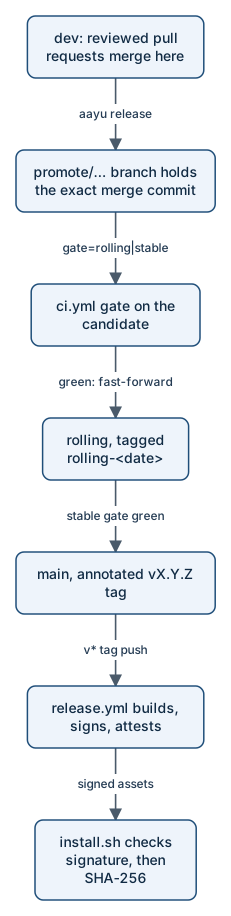
The gate tests the same commit that lands; the signature names the workflow and tag that built it.
The ladder and its gates
Why gate a promotion at all, when every pull request already passed CI? Because the merge of dev into rolling
is a new commit that nobody has tested yet. So the gate runs on that merge commit itself, before any branch moves:
- Build the candidate. A
promote/…branch holds the exact non-fast-forward merge commit that will land, with the messageRolling snapshot: <timestamp>orRelease: vX.Y.Z, signed off. - Gate it. Dispatch
ci.ymlon the candidate withgate=rolling(fordevtorolling) orgate=stable(forrollingtomain). - Land it. Push that same commit to the target branch, which is a fast-forward, then tag it.
A dispatched ci.yml always runs the whole pull request suite: build (vet, unit tests, the build matrix, and
the binary size budget), generate-drift, lint, commits, security, docs, and release-snapshot. The
path filters that let a pull request skip jobs are off for dispatches. On top of that suite:
| Gate | Extra jobs |
|---|---|
rolling |
integration (build tag integration, race detector), benchmarks, evals-gate |
stable |
everything in rolling, plus extended-integration (live tests with AAYU_LIVE=1) and smoke on Ubuntu, macOS, and Windows |
release-snapshotis the production validation. It runs a real signed goreleaser snapshot, then runsinstall.shagainst it: the genuine archive must install, and a flipped byte, a checksum rewritten to match the flipped byte, and a signature from a workflow other thanrelease.ymlmust all be refused.evals-gatereads tier-2 eval results (tests of the agents' own skills, run byevals.yml) for the commit being promoted, and compares each gating group withmain's baseline. Missing results fail the gate.- Security scans (gitleaks, semgrep, osv-scanner, and the licence scans) run in the
securityjob, which is part of the suite in both gates.
Tip: the founder policy for this repository is that promotions need no human approval. The gate is the control, and it is never skipped. Promotion still happens only on the release schedule or an explicit request.
What aayu release does
aayu release <release> --to rolling|main drives those three steps for one Release work item, then does the
bookkeeping. It lives in internal/cli/release.go.
- Refusals first. It refuses CI, and refuses a token that belongs to a bot or to a login in
[identity] bot_logins. An agent may run it under a person's account (founder policy): there is no TTY prompt for agents, because the gate is the control. A person at a terminal is still asked to confirm, or passes--yes. The registry marks it human identity, stable-request, and halt gate, and exposes it over MCP (the Model Context Protocol server that hosts call) only whereexpose_writesallows writes. - The stable-release request.
--to mainneeds an explicit request that an agent cannot make. Either a person confirms at their own terminal, or a comment on the Release issue has the first lineStable release: vX.Y.Zand is written after the Release's rolling snapshot, by an account that is not a bot and has write, maintain, or admin access, with no<!-- aayudha:marker. aayu never writes such a comment, and the pre-tool hook refuses an agent's shell command that would. Without one the rung exits 4 and promotes nothing; the ledger records who asked and where. - Checks before anything moves. The Release issue must pass Ready. Every story it lists must be in the
promoted range or already shipped. Promoting to
mainneeds avX.Y.Zversion that has no tag yet, and the Release'srollingrung must be on the ledger with its commit still onrolling. - Dry run. With
--dry-runit stops after computing the plan: the candidate, the tag, the stories it would stamp, and the release notes. Nothing is pushed. - The gate. For
rolling, it first dispatchesevals.ymlon the source tip and waits. Then it dispatchesci.ymlon the candidate. A gate that fails is re-run once for its failed jobs (a transient failure); if it is still red, nothing is promoted and the candidate branch is deleted. - Bookkeeping. After the push and the tag it stamps every shipped story
released, writes release notes throughtell(which cites only proven Features and refuses avoided words), and makes each Goal and Initiative above those stories due formeasure28 days later. - Records. It writes
releases/<n>/<target>.jsonandmeasure/due/<issue>/<tag>.jsonto the ledger branch, and the Shipping evidence section of the Release issue.
Tags
| Branch | Tag | Kind | Example |
|---|---|---|---|
rolling |
rolling-<date>, then rolling-<date>.<n> for the n-th snapshot of a day |
lightweight | rolling-2026-10-12.4 |
main |
vX.Y.Z |
annotated, Release vX.Y.Z: <title> |
none yet |
A snapshot build never reads a rolling-* tag as its version. Before goreleaser runs, ci.yml and installers.yml
set GORELEASER_CURRENT_TAG to the newest v* tag (a release ranks above its prereleases), so a snapshot is named
after the next patch, for example 0.2.1-snapshot.a7efe40.
The signed build
A v* tag push runs release.yml. Its verify-tag job refuses a tag that is not vMAJOR.MINOR.PATCH[-PRE],
whose commit is not on main, or that is lightweight. Then goreleaser builds six targets (Linux, macOS, and
Windows on amd64 and arm64) with CGO_ENABLED=0, so each is one static binary. From .goreleaser.yaml:
builds:
  - id: aayudha
    main: ./cmd/aayudha
    binary: aayudha
    env:
      - CGO_ENABLED=0 # ground rule 2: one static binary
    goos: [linux, darwin, windows]
    goarch: [amd64, arm64]
    flags: [-trimpath]
…
checksum:
  name_template: checksums.txt
  algorithm: sha256

sboms:
  - artifacts: archive # syft, one SPDX SBOM per archive

signs:
  - id: cosign-keyless
    cmd: cosign
    artifacts: checksum
    signature: "${artifact}.sigstore.json"
    args: ["sign-blob", "--bundle=${signature}", "--yes", "${artifact}"]
    output: true
Signing is keyless: cosign gets a short-lived certificate from Sigstore for the workflow's GitHub OIDC (OpenID
Connect) identity, so there is no private key to steal. The certificate names
.github/workflows/release.yml@refs/tags/<tag>. Only checksums.txt is signed, and it covers every archive.
Then release.yml adds SLSA (Supply-chain Levels for Software Artifacts) build provenance with GitHub's own
attestation action, over the same checksums:
      - name: SLSA build provenance
        uses: actions/attest-build-provenance@4d101475d8b20a2381f78447822ac1eab6504dd8 # v4.2.2
        with:
          subject-checksums: dist/checksums.txt
The same job then runs install.sh against dist/ and checks aayu version. A smoke job installs the
published release from GitHub on Ubuntu and macOS, the way a user does.
The install check
install.sh verifies two things, in order, before it extracts anything. From install.sh:
# Only release.yml on exactly this tag may have signed the checksums.
tag_re="$(printf '%s' "$version" | sed 's/[.+]/\\&/g')"
identity_re="^https://github\\.com/rahulnakmol/agentic-ayudha/\\.github/workflows/release\\.yml@refs/tags/${tag_re}\$"
…
MSYS_NO_PATHCONV=1 MSYS2_ARG_CONV_EXCL='*' "$cosign" verify-blob \
  --bundle "$(native "$tmp/checksums.txt.sigstore.json")" \
  --certificate-identity-regexp "$identity_re" \
  --certificate-oidc-issuer "$ISSUER" \
  "$(native "$tmp/checksums.txt")" >/dev/null 2>"$tmp/cosign.log" || {
  cat "$tmp/cosign.log" >&2
  die "signature verification failed: checksums.txt was not signed by $REPO release.yml for $version"
}

want="$(awk -v f="$archive" '$2 == f { print $1 }' "$tmp/checksums.txt")"
[ -n "$want" ] || die "$archive is not listed in the signed checksums.txt"
[ "$(sha256 "$tmp/$archive")" = "$want" ] || die "checksum mismatch for $archive: the archive was tampered with or corrupted"
If cosign is not on PATH, the script downloads cosign v3.1.3 and refuses to run it unless its SHA-256 matches
a value pinned in the script for that OS and architecture. aayu self-update pins the same identity and also
checks the SLSA provenance attestation.
Package managers
goreleaser writes a Homebrew cask, a Scoop manifest, and winget manifests, but never uploads them
(skip_upload: true). Three separate release.yml jobs publish them, each in its own GitHub environment with its
own token, so the build job never holds a token for another repository. Prereleases are not published there.
Each manifest carries the archive's SHA-256, and the package manager checks the download against it; none of them
checks the cosign signature. installers.yml proves that the Scoop manifest refuses a wrong hash.
Honest status: v0.1.0 was released on 15 October 2026 (tag
v0.1.0, commit78bd4aeonmain): the tag check, the signed build, provenance, and the smoke installs on Linux and macOS passed. Its Homebrew, Scoop, and winget jobs failed, so at that release the tap and the bucket stayed empty andinstall.shwas the way to install. Since v0.2.0, Homebrew and Scoop have aayudha (the tap's cask and the bucket's manifest are at 0.2.0). winget does not yet: its package has passed validation and is waiting for a moderator in microsoft/winget-pkgs pull request 454680. The promotion record below is the earlier rolling snapshotrolling-2026-10-12.4, which carried the story.
A real promotion record
This is the rung that Release 144 wrote, from git show origin/ledger:releases/144/rolling.json, trimmed:
{
  "repo": "rahulnakmol/agentic-ayudha",
  "release": 144,
  "source": "dev",
  "target": "rolling",
  "source_sha": "a631247bd29c6e3252bd82a9d4a07f796f594448",
  "commit": "9991cd392d282692aa9f5309d67ecc5c3362627a",
  "message": "Rolling snapshot: 20261012T1447Z",
  "tag": "rolling-2026-10-12.4",
  "candidate": "promote/rolling-20261012T1447Z",
  "gate": {
    "workflow": "ci.yml",
    "id": 38266833172,
    "url": "https://github.com/rahulnakmol/agentic-ayudha/actions/runs/38266833172",
    "conclusion": "success",
    "attempts": 1
  },
  "artifacts": [
    …
    {
      "name": "release-snapshot",
      "digest": "sha256:00b9b8b4a19283114a1ceb9af13f62508b7cc80872eba64d3797f1fef57062c0",
      "size": 65125205
    }
  ],
  "stories_released": [
    132,
    133,
    134
  ],
  …
  "referenced_not_merged": [
    70
  ],
  "release_notes": "tell/release/rolling-2026-10-12.4.md",
  "measure_due": [
    {
      "issue": 125,
      "type": "goal",
      "due": "2026-11-09",
      "release": 144,
      "tag": "rolling-2026-10-12.4",
      …
    },
    …
  ],
  "promoted_by": "rahulnakmol",
  "promoted_at": "2026-10-12T14:47:06Z"
}
Story 70 was referenced by a pull request in the range but had not merged, so it was not stamped.
Invariants
- A branch moves only to the commit the gate tested, and a red gate leaves no moved branch, no tag, no candidate
branch, and no stamp; a dry run moves nothing (
internal/cli/release.go,TestReleaseLadder). - A failure before landing promotes nothing, and a failure after landing still exits non-zero
(
internal/cli/release.go,TestReleaseFailsClosed,TestReleaseRefusesBeforeLanding). - Only a person's own account, outside CI, can promote, and
mainmoves only on a person's stable-release request (humanAccountininternal/cli/tell.go;stableRequestininternal/cli/release.go;StableRequestCommandininternal/hosts/hook.go;TestReleaseLadder). - A
v*release is built only from an annotated tag onmain(verify-tagin.github/workflows/release.yml). install.shinstalls nothing unless the signature namesrelease.ymlon the exact tag and the archive matches its signed checksum (therelease-snapshotjob in.github/workflows/ci.yml, on every pull request that touches Go or the installer, and on every gate).- Every action is pinned by full commit SHA and every downloaded tool by SHA-256 (convention in every workflow;
.github/is a protected path in.github/CODEOWNERS).
Where it lives in the code
- internal/cli/release.go and internal/cli/release_test.go
- .github/workflows/ci.yml: the suite and both gates
- .github/workflows/release.yml: tag check, signed build, provenance, package managers
- .goreleaser.yaml
- install.sh and .github/workflows/installers.yml
- internal/cli/selfupdate.go
- CONTRIBUTING.md: the promotion procedure; design history in BUILD-PLAN.md
Read next
- Security and the threat model
- The story version: Release it