How it works
This track is for engineers. The story shows what aayudha does on a real day; these pages show exactly how: the parts, the file formats, the guarantees, and where each one is enforced in the code. Every page has a diagram, real excerpts from this repository, a list of invariants, and links into the source.
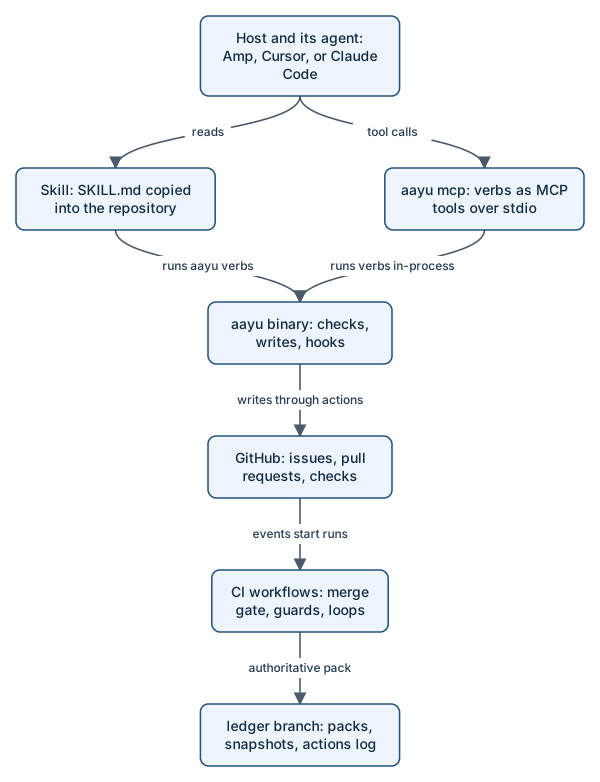
The whole system on one page. Architecture walks through it.
Start with the shape
| Page | What you will learn |
|---|---|
| Architecture | One static binary, four hosts, four surfaces per verb, which steps your agent's model reasons in versus the binary's own model calls, and the vagueness gate |
| The verb registry and code generation | How 34 verbs are declared once, what go generate builds from them, and how CI catches drift |
Who may do what
| Page | What you will learn |
|---|---|
| Trust model and identities | Humans, the bot App, CI, and untrusted input; the human pass; solo mode; the token broker |
| The ledger branch | Where Ready snapshots, plans, proof, ship records, and logs live, who writes them, and how writes stay consistent |
| Configuration, secrets, and the audit trail | Config layers, secret backends, the hash-chained actions log, and how audit reconciles it with GitHub |
Proof
| Page | What you will learn |
|---|---|
| Proof packs | The pack.json format, how promises map to evidence, and advisory versus authoritative packs |
| The merge gate | Why the gate runs from the base branch, the sandbox verify runs in, and inspect's structured verdict and fix cycle |
| Code review in the gate | The default review: the code-review environment's model, how to set it up, and review apps as an option |
| Floors in detail | Every floor, its tool and pinned version, its threshold, when it is skipped, and how waivers work |
| Verify skills, feature maps, and behaviour checks | The feature map format, the drift check, how behaviour checks run with no model, the maintain hand-off, and red-on-base proof for Bugs |
Models and quality of the agents
| Page | What you will learn |
|---|---|
| The model gateway and lanes | Lanes and their default models, the different-vendor rule for reviewers, wire formats, cost accounting, budgets, and the breaker |
| The eval harness | How skills are tested: tiers, groups, pass^k, judges, baselines, and the gates that use them; retro's flow numbers, evolve's rules, and the coverage ratchet |
| Hand-offs, agent environments, and loops | Handing a story to another agent's cloud, the environment it builds in, and scheduled and event loops on each host |
Shipping it safely
| Page | What you will learn |
|---|---|
| Releases and the supply chain | The promotion gates, goreleaser, cosign signatures, provenance, and what install.sh checks |
| Security and the threat model | The threats aayudha is built against, the control for each, and the kill switch |
| Extending aayudha | Adding a verb, a floor, a host, or an integration, and which paths need a human review |
Honest status: these pages describe the code as it is today, including the parts that wait on setup in this repository: no bot App installed, no package-manager publishing yet, and one human, so solo mode applies. Each page says where.
Read next
Start with Architecture. If you would rather see it all happen first, read the story.