The human pass and solo mode
Agents do most of the work in aayudha, but some decisions belong to people: merging a change, accepting a decision, publishing, releasing. The human pass is how aayudha makes sure a person really made them, and solo mode is what happens, honestly recorded, when there is only one person.
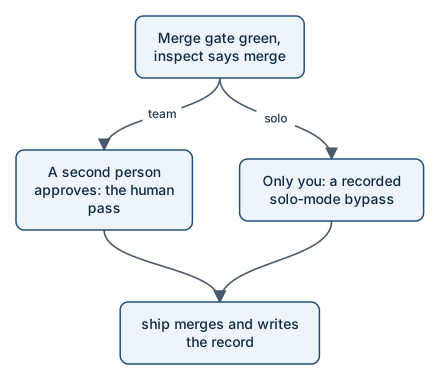
A person always signs off. Working alone, you record that you did.
The human pass
A human pass is an approving review on the pull request from a person's GitHub account. aayudha counts it only when the account is not a bot, and not one of the bot logins you have configured. That is why agents and CI write as a bot identity at Level 3: so an agent's approval can never be mistaken for yours.
ship will not merge without one. Publishing with tell refuses agents altogether. release lets an agent
promote behind the full gate, but main moves only on a person's stable-release request.
Solo mode
GitHub does not let you approve your own pull request. So on a team of one, a true human pass is impossible. aayudha does not fake one. Instead:
- You post a comment on the pull request that starts with "Solo-mode bypass:" and says why.
- You run
aayu ship <pr> --solo-bypass. It checks you really are alone: no bot App, and no second person paired with a seat. - The ship record and the story's Outcome say "Human pass: none possible", with a link to your comment.
auditlists every solo-mode bypass in its own section.
The same goes for plans on the risky layers: plan --solo-bypass records that nobody reviewed the plan, rather than
claiming you did.
In the story: benefits-qa was built in solo mode. Each of the five pull requests merged under a recorded solo-mode bypass, and three plans were recorded as bypasses too. None was written down as an approval.
When you add a second person
Solo mode switches off by itself. Pair a teammate with a seat (aayu seat add <seat> --human <login>), and their
approval is required again for the layers that seat owns.
Earning autonomy
At Level 3, a layer can earn the right to merge without waiting for a person: 20 merges in a row on that layer with no human correction (no requested changes, no human commits, no reverts, no linked bugs). Only merges whose review was by another model family, or by a person, count: a same-family review neither counts nor breaks the streak, and neither does a merge with no review on record. A protected workflow computes the streak from the merge history, so no agent can change it. The risky layers, domain policy, stored data, and the platform, always need a person, whatever the streak.
Terms are defined in the glossary.
Under the hood: how a person's approval is told apart from a bot's, and what solo mode checks, is in trust and identities.
Working alone every day? Run it alone: the solo founder has the whole routine, including the inbox.
What's next
Once a change is merged, it climbs the release ladder. See dev, rolling, main.