The model gateway and lanes
Every verb that needs judgement runs in a lane: a named class of model work, such as build or review, with a
settled default model for each host. Most of the time the host's own model does the reasoning inside a skill. A few
verbs call a model directly from the aayu binary, and those calls go through one model gateway: it picks the
model, keeps the reviewer in a different model family from the builder, speaks the provider's wire format, prices every
reply, and stops all agent lanes when spend reaches the budget.
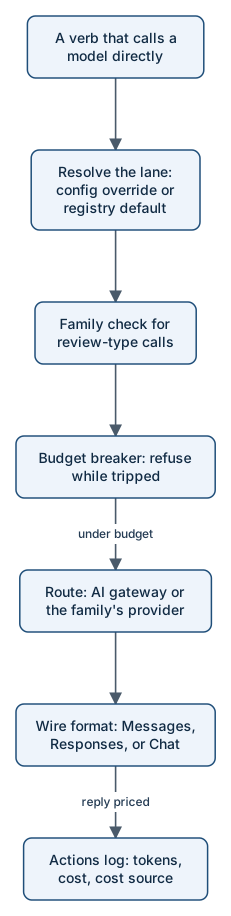
Each priced reply adds to the breaker's count, so the call that reaches the limit is the last one.
Lanes and their defaults
The registry in internal/verbs/registry.go declares six lanes. Each verb names exactly one lane, and each lane has a
default for each host. The table shows Amp, Cursor, and Claude Code; aayu models show lists every host, OpenAI Codex
included.
| Lane | What it does | Amp | Cursor | Claude Code |
|---|---|---|---|---|
build |
Writes code and artifacts | Amp medium | Grok 4.7 (legacy plan: Claude Opus 5.5) | Claude Opus 5.5 |
spec |
Specs, decisions, briefs, copy | Amp medium | Grok 4.7 (legacy plan: Claude Opus 5.5) | Claude Opus 5.5 |
plan |
Slices and plans work | Amp medium | Grok 4.7 (legacy plan: Claude Opus 5.5) | Claude Opus 5.5 |
review |
Adversarial code and spec review | GPT-6.1 Sol | Grok 4.6 (legacy plan: Grok 4.7) | GPT-6.1 Sol |
ui-review |
Visual and interaction critique | Amp high | Grok 4.6 (legacy plan: Gemini 3.8 Flash) | Gemini 3.8 Flash |
chore |
Cheap mechanical work | Amp low | Composer 2.5 (legacy plan: Haiku 5.5) | Haiku 5.5 |
Cursor's column follows [hosts.cursor] plan (the review-ladder decision of 2026-10-17). Cursor's plans from 12 October 2026, x and the
default, include only Cursor's own models (Grok 4.7, 4.6, 4.5, and Composer 2.5); Claude, GPT, and Gemini are
list-price pay-as-you-go there. aayu cannot tell the plans apart, so it defaults to the one that never spends
list-price money by surprise. Set plan = "legacy" for a legacy Pro, Pro+, or Ultra plan, which still includes Claude
and Gemini, in your user config (or AAYU_HOSTS__CURSOR__PLAN); the plan is yours, so a checkout's config cannot set
it. A checkpoint records the build model the plan picked, so a later plan change does not relabel past builds. On x every lane is one family, so review and ui-review use another Grok tier and their reviews are
labelled same-family; the merge gate's reviewer app can still be of another family. Composer's base model is
unpublished, so its family is unknown, and a review between it and any build is same-family.
Three rules shape this table:
- The family rule. A reviewer must come from a different model family than the builder. A model that wrote the
code is a poor judge of it, and two models from the same vendor tend to share blind spots.
reviewandui-revieware markedAdversarial, and their defaults are never in the builder's family, except on a host plan that includes one family (Cursor'sx), where the review is labelled same-family. - Host exclusions. A host lists the families it cannot run. Cursor excludes the
openaifamily, so thereviewlane on Cursor defaults to Grok (xai) instead of GPT-6.1 Sol. - Host-managed modes. On Amp, the default is a mode (Amp low, medium, high) and the host picks the model behind
it. The binary cannot call a mode, so a direct call from an Amp session uses the Claude Code default for that lane
(
DirectHost).
The review default also names an escalation: GPT-6 Astra at high reasoning effort, used when a caller marks a
review as heavy. The ui-review default on Cursor, Claude Code, and Codex is Gemini 3.8 Flash at high reasoning
effort (gemini-3.8-flash, google family), so it is never in the family of an anthropic or OpenAI builder. Every
model judgement of a UI goes through this lane: aayu review's lane A, polish, which re-runs it, and aayu verify's
advisory look at its screenshots, which never decides whether a floor holds. It is
interim until the AI gateway routes the target, gemini-4-argon-high, which needs a paid Google plan.
Needs setup: without Copilot (below), the ui-review lane needs a model key: the AI gateway's (
[models.gateway]) or Google's. Without one, and in the merge gate, which has no model key,aayu verifyrecordsscreenshot_review.skippedwith the reason instead of findings, andaayu reviewstops. Set the key withaayu auth set-secret <name>. Verify sends only screenshots that its redaction pass read with OCR, so it also needstesseractinstalled.
Gemini 4 Argon through Copilot (the default where Copilot is set up). The binary's ui-review calls (review lane
A, aayu polish, and verify's screenshot review) run on Gemini 4 Argon at high effort through Copilot CLI whenever
copilot is on your PATH and signed in, on any host. Otherwise they run on gemini-3.8-flash at high effort through
the AI gateway, as above.
-
How it runs.
copilot --model gemini-4-argon --reasoning-effort high, the prompt on stdin, the screenshots as attachments, no tools, in an empty directory with a freshCOPILOT_HOME, so no repository hooks, MCP servers, or custom instructions load. It signs in with thecopilotsecret, elseCOPILOT_GITHUB_TOKEN, which goes to that process only, withCOPILOT_GH_HOST(elseGH_HOST) for a GitHub Enterprise host. -
What it costs. Each call is charged the AI credits Copilot reports: input at 2 USD and visible output at 10 USD per million tokens, with reasoning not billed, about 0.043 USD for a lane A call (two probes, 2026-10-18). The budget breaker counts it like any other call.
-
When it falls back. When
copilotis not installed or not signed in, lane A uses flash from the start, and stderr and the label say why (gemini-3.8-flash (gemini-4-argon through Copilot is unavailable: …)). When a call fails or its reply misses the schema, that call and every later one go to flash (… (the Copilot route failed: …)). The review always runs. -
Reviewer and builder. Argon is google family, so it still never reviews a google builder's work.
-
Turning it off. In your user config (a repository's config cannot set this row):
[models.ui-review.copilot]
model = ""   # lane A always uses gemini-3.8-flash through the gateway
Another Copilot model ID in that row runs that model through Copilot instead.
Honest status: the ux evals that gate this lane measured
gemini-3.8-flashonly. CI has no Copilot credential, so it always takes the fallback, and its numbers are flash's. A local run with Copilot signed in reviews on Argon, which those gating runs did not measure.
CopilotCLI and CopilotReady in internal/models/copilot.go, TestCopilotCLI and TestCopilotUIReviewRoute.
How aayu models resolves a lane
aayu models prints the model, family, source, and route for every lane on every host (or only one host with
--host). It uses the same resolver as a real call, in internal/models/resolve.go:
- Look up the registry default for the lane and host.
- If
[models.<lane>.<host>]exists in config, take itsmodel. The family is thefamilykey, or it is inferred from the model ID prefix (claude-,gpt-,gemini-,grok-). An unknown family is a configuration error. - If the host excludes that family, fall back to the registry default, set the source to
fallback, and log one line that explains the substitution. - For a direct call, if the result is a host-managed mode, resolve the lane again for the direct host (source
direct). A heavy call then swaps in the escalation model, unless config chose the model.
The source column tells you which rule won: default, config, fallback, or direct.
Who calls models from the binary
Ground rule 5 in the build plan says that inside a host, the host's model reasons. The binary calls a model itself only where the work must not depend on the host:
inspectwith[inspect] reviewer = "model"(registry modedirect); by default the merge gate reads an agent app's review instead.reviewlane A (hybrid: the host reasons, then the binary makes one direct pass).- The
briefadversarial pass (hybrid), which checks the draft for claims its sources do not support. triagewhen a person runs it without--asand holds a key (hybrid); it never runs in product CI, where the host's model or an agent app you @-mention classifies the issue.- The eval judge in the eval harness, which is not a verb.
inspect, review, and brief call models.CheckFamilies before they call the model. It refuses a reviewer whose
family equals the builder's, and a reviewer with no concrete family at all.
The gateway: routes and wire formats
RouteFor in internal/models/client.go decides where a call goes. When [models.gateway] base_url is set, every
model goes to that one AI gateway, with the key from the secret that [models.gateway] secret names, sent as a Bearer
token. Otherwise each family goes to its own provider, with a key in a secret named after the family. base_url and
secret are read only from the user config, AAYU_MODELS__GATEWAY__* variables, or --set, never from the checkout:
a PR's .aayudha/config.toml cannot choose where your keys are sent (Load in internal/config/load.go).
The client speaks three wire formats:
| Style | API | Path | Default for |
|---|---|---|---|
messages |
Anthropic Messages | POST /messages |
anthropic |
responses |
OpenAI Responses | POST /responses |
openai |
chat |
OpenAI Chat Completions | POST /chat/completions |
google, xai |
Through the gateway, the style is chosen per model: a styles entry for the model ID, then one for its family, then
api_style, then the family default. The family always comes from the model ID, never from the endpoint, so the family
rule holds even when every model sits behind one URL.
Keys never live in config. Config names a secret, and internal/secrets resolves the name across the OS keychain, an
environment variable, and an encrypted file. The environment variable is AAYU_SECRET_ plus the name in upper case,
with - as _: the secret ai-gateway is AAYU_SECRET_AI_GATEWAY, and a direct Anthropic key is
AAYU_SECRET_ANTHROPIC.
Cost and budgets
Every direct call is one model.call record in the actions log, with input and output tokens, the cost in US dollars,
and where the cost came from. Cost in internal/models/gateway.go picks the first figure it has:
reported: the cost the endpoint returned inusage.cost.price-table: tokens times the[[models.prices]]entry for the model ID.list-price: tokens times the model's published price inmodels.ListPrices(internal/models/prices.go), each with its provider's pricing page and the date it was read. The AI gateway the evals use reports no cost, so this is what they are charged (Appendix B D-3.4p).fallback-rate: 15 USD per million input tokens and 75 USD per million output tokens. This is deliberately high, so an unpriced model trips the breaker early rather than never; the evals name such a model in their results' warnings.
Cache reads and cache writes are charged at their own rates when the price has them, and a prompt past a model's long-context threshold is charged at its long-context rates.
The breaker enforces [budget]. Before each call, Check refuses if agent lanes are paused, if the story has
gone over its limit, or if the local day has reached its limit. After each call, Add adds the spend. When a story
goes over per_story_usd (exactly the limit is still allowed, as it is for a build's cost_usd) or the day reaches
per_day_usd (reaching it exactly counts), it writes the pause file
.aayudha/state/paused, pages through [notify], and returns ErrBudget. The CLI maps that error to exit code 6.
Pages are keyed by scope, and [notify] sends each key at most once per local day, so a tripped breaker pages once.
While the pause file exists, every direct call is refused, and the loop guard (aayu hook loop:<name>, the first step
of every scheduled loop) exits 6 too. aayu resume removes the pause file.
The other [budget] keys are enforced elsewhere. per_pr_inspect_max caps inspect spend on one pull request across
all its cycles. ci_minutes_month makes the loop guard exit 6 in GitHub Actions once the loops' runs this month have
used that many minutes. [autonomy.budget] is a different budget: the wall time, spend, and failed attempts one build of a story may use.
Its cost_usd applies only when model calls are pay-as-you-go: a [models.gateway] endpoint or a direct provider's
key is configured, or a host reports its spend in AAYU_COST_USD. Otherwise there is no cost limit, because
subscription use reports no cost. per_story_usd is at least cost_usd, so the breaker never stops a story before its
build budget does. When build exceeds the budget, the story moves to status:blocked, the owner is paged, and
build exits 4.
Key data and file formats
The lane types and table, from internal/verbs/registry.go:
// Lane is a class of model work with per-host defaults.
type Lane struct {
    ID          LaneID
    Summary     string
    Adversarial bool // reviewer lanes: the model family must differ from the builder's
    Defaults    []ModelDefault
}
…
// Lanes lists the model lanes with their settled per-host defaults.
var Lanes = []Lane{
    {ID: LaneBuild, Summary: "Writes code and artifacts.", Defaults: builderDefaults()},
    {ID: LaneSpec, Summary: "Authors specs, decisions, briefs, and copy.", Defaults: builderDefaults()},
    {ID: LanePlan, Summary: "Slices and plans work.", Defaults: builderDefaults()},
    {ID: LaneReview, Summary: "Adversarial code and spec review.", Adversarial: true, Defaults: []ModelDefault{
        reviewDefault(HostAmp),
        {Host: HostCursor, Model: "Grok 4.6", ID: ModelGrokPrior, Family: FamilyXAI, Plan: PlanX},
        {Host: HostCursor, Model: "Grok 4.7", ID: ModelGrok, Family: FamilyXAI, Plan: PlanLegacy},
        reviewDefault(HostClaude),
    }},
    …
}
The ModelDefault type, from the same file (trimmed):
type ModelDefault struct {
    Host             HostID
    Model            string // display name, or the host mode (e.g. "Amp medium")
    ID               string // model ID at the AI gateway or provider; empty for host-managed modes
    Family           Family
    Effort           string // reasoning effort to request; empty means the provider default
    Escalation       string // what to use on escalation or for heavy work; empty if none
    EscalationID     string // model ID of the escalation, when it is a model rather than a host mode
    …
}
The budget defaults, from internal/config/defaults.toml:
# A build's budget. cost_usd applies only when aayu's own model calls are pay-as-you-go (a [models.gateway] endpoint or a
# direct provider's key is configured, or a host reports spend in AAYU_COST_USD); otherwise there is no cost limit,
# since subscription use reports no cost.
[autonomy.budget]
wall_hours = 8
cost_usd = 60.0
attempts = 3

# Spend limits enforced by the model gateway's circuit breaker (WP1.6).
[budget]
per_story_usd = 60.0 # at least autonomy.budget.cost_usd, so the breaker never stops a story before its build budget
per_day_usd = 100.0
per_pr_inspect_max = 5.0
ci_minutes_month = 2000
The provider-neutral reply every wire format decodes into, from internal/models/client.go:
// Response is a provider-neutral reply.
type Response struct {
    Text      string
    Model     string
    TokensIn  int
    TokensOut int
    CostUSD   float64 // reported by the endpoint, when it reports one; else 0
    …
    StopReason string
    Truncated  bool
}
Invariants
- Every lane has a default on every host; a default's model ID belongs to its declared family; an escalation never
changes family; no default uses a family its host excludes; and an adversarial lane's default is never in the
builder's family. Enforced by
internal/verbs/registry_test.go,TestRegistry. - A configured model whose family the host excludes falls back to the registry default, and the substitution is
logged. Enforced in
internal/models/resolve.go,TestLaneResolution. - A reviewer's family differs from the builder's on every story, and a host-managed reviewer is refused. Enforced by
CheckFamiliesininternal/models/resolve.go,TestReviewerFamilyMustDiffer; called frominternal/cli/inspect.go,internal/cli/review.go,internal/cli/brief.go, andinternal/evals/tier2.go. - A host-managed mode is never called directly. Enforced by
RouteForininternal/models/client.go,TestRouting. - A reported cost wins over the price table, which wins over the fallback rate; an unpriced model is charged at 15 and
75 USD per million tokens. Enforced by
Costininternal/models/gateway.go,TestBudgetBreaker. - Spend that reaches a limit trips the breaker once, pauses agent lanes, pages once, and refuses every later call
before it reaches the provider. Enforced by
Breakerininternal/models/gateway.go,TestBudgetBreakerandTestNotifyGatingAndDedupe; exit 6 is mapped ininternal/cli/root.go. - Each wire format sends the right body and reads tokens, stop reason, and truncation from its own reply shape.
Enforced in
internal/models/client.go,TestWireFormats,TestStopReasons, andTestCacheTokensCount.
Where it lives in the code
- internal/verbs/registry.go: lanes, hosts, families, model IDs,
DirectHost. - internal/models/resolve.go: lane resolution and the family check.
- internal/models/client.go: wire formats, routing, direct providers.
- internal/models/gateway.go: the gateway call, cost, and the breaker.
- internal/models/structured.go: JSON replies validated against a schema.
- internal/cli/models.go:
aayu models. - internal/config/defaults.toml:
[budget]and[autonomy.budget]. - internal/secrets/secrets.go: secret names and
AAYU_SECRET_*variables. - .github/workflows/models-live.yml: live calls through the AI gateway.
Honest status: this repository's only model key is the secret of the
ai-gatewayenvironment, which only thedev,rolling, andmainbranches may use. Neither the founder's machine nor an agent's sandbox holds a key, soreviewlane A and thebriefadversarial pass run in theaayudha-model-lanes.ymlworkflow, and live gateway tests never run on pull requests. Each process seeds the breaker from its clone's actions log when it builds the gateway (Breaker.SeedLog), so the budgets count every process in that clone; a CI run starts from a fresh clone, so its breaker sees only that run's spend. The breaker also cannot see what a host's own model spends inside a skill.
Read next
- The eval harness: the judge is a direct call through this gateway.
- The merge gate: where
inspectmakes its direct call.