Architecture
aayudha is one static Go binary, aayudha (alias aayu), plus a set of skills that it copies into your coding
host. The host's agent reads a skill and decides what to do. The binary does every deterministic check and every
write. GitHub holds the work, and an orphan ledger branch holds the record. This split exists so that the part
that reasons (a model) is never the part that certifies or writes.
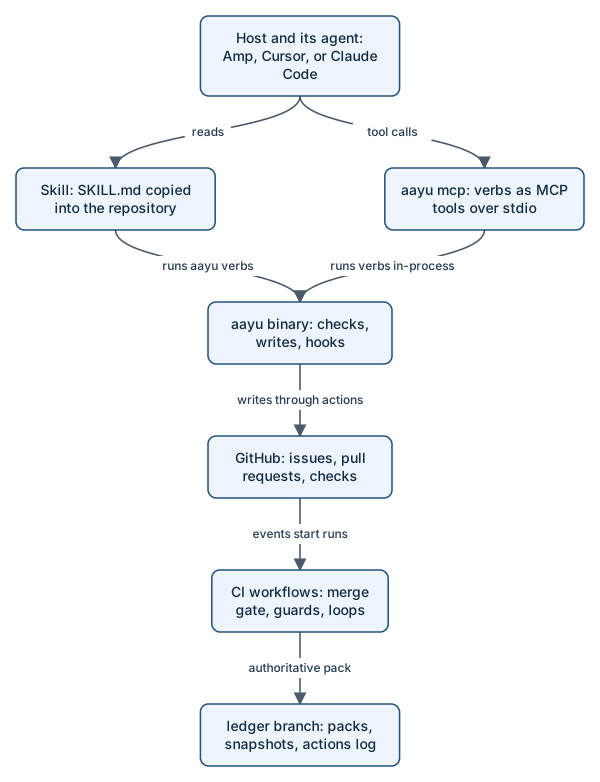
The agent decides; the binary checks and writes; CI certifies. The binary also writes Ready snapshots and the actions log to the ledger itself.
One binary, embedded assets
Ground rule 2 in the build plan asks for one static binary built with CGO_ENABLED=0. The
release build (.goreleaser.yaml) and the cross-compile in the build job of ci.yml both set it. The only
required external tools are git and git-lfs, because go-git has no LFS or linked-worktree support and the
ledger needs both. aayu doctor reports everything else as optional.
The binary carries its own assets. The root package embeds four source trees exactly as committed:
// Assets holds skills/, work-items/, hosts/, and seats/ exactly as committed.
//
//go:embed skills work-items hosts seats
var Assets embed.FS
From embed.go. cmd/aayudha/main.go passes aayudha.Assets to cli.Run, so aayu install copies skills
from the binary, not from a checkout. Other packages embed their own files the same way: the default config
(internal/config/defaults.toml), the MCP tool schemas (internal/mcp/schemas/*.json), the proof pack schema, and
the workflow templates that aayu init --gates installs (internal/initrepo/*.yml).
install.sh installs the binary as aayudha and links aayu to it (on Windows it copies aayu.exe).
Four surfaces for one verb
The registry (internal/verbs/registry.go) declares 34 verbs and 15 plumbing commands. Each command lists the
surfaces it appears on:
- CLI. Every command.
internal/cli/root.gobuilds one cobra command per registry entry at start-up, with positional arguments, flags, and validation taken from the entry's inputs. - Skill. Every verb except
initandinstall.skills/<verb>/SKILL.mdhas generated frontmatter and a hand-written body that tells the host's model whichaayucalls to make. - MCP.
aayu mcpserves verbs as Model Context Protocol (MCP) tools over stdio. Read verbs are always exposed. Write verbs are exposed only when[mcp] expose_writes = true(default false). Human-only verbs (ship,release,decide,respond,init,install) are never exposed, and neither are human-only inputs such asship --solo-bypass. The server runs each tool call in-process as an agent (AAYU_AGENT=1), so--yesand other human paths are refused. - Plumbing. Commands that are not verbs:
config,auth,actions,models,mcp,hook,halt,resume, and others. They have no skill and no lane.
See the verb registry for how one Go file drives all four.
Hosts
There are four primary hosts: Amp, Cursor, Claude Code, and OpenAI Codex (verbs.Hosts). aayu install --host <host> plans
the edits and --apply writes them. Skill copies are real files, never symlinks, and their hashes go in
.aayudha/lock.toml.
| What | Amp | Cursor | Claude Code |
|---|---|---|---|
| Skills | .agents/skills/<verb>/ |
.agents/skills/<verb>/ |
.claude/skills/<verb>/ |
| MCP server | amp.mcpServers in ~/.config/amp/settings.json |
.cursor/mcp.json |
.mcp.json, enabled in .claude/settings.json |
| Hooks | .amp/plugins/aayudha.ts |
.cursor/hooks.json |
.claude/settings.json |
| Agent guidance | AGENTS.md sections |
AGENTS.md sections |
CLAUDE.md stub that imports @AGENTS.md |
The paths are constants in internal/hosts/install.go (tabs shown as spaces):
const (
    LockPath       = ".aayudha/lock.toml"
    AgentsSkills   = ".agents/skills" // Amp and Cursor
    ClaudeSkills   = ".claude/skills" // Claude Code
    AgentsMD       = "AGENTS.md"
    ClaudeMD       = "CLAUDE.md"
    ClaudeMCP      = ".mcp.json"
    ClaudeSettings = ".claude/settings.json"
    CursorMCP      = ".cursor/mcp.json"
    CursorHooks    = ".cursor/hooks.json"
    AmpPlugin      = ".amp/plugins/aayudha.ts"
    AmpSettings    = ".config/amp/settings.json" // relative to the user's home
    ServerName     = "aayudha"                   // MCP server name in every host
    LockVersion    = 1
)
Every hook runs "<absolute path to aayu>" hook <name> --host <host> and nothing else. There are two hooks.
session-start reports skill copies that differ from the lock file. pre-tool blocks agent tool calls (exit code
2) while the repository is halted or the budget breaker has paused agent lanes. The binary detects the host from
an environment variable the host sets (AMP_THREAD_ID, CLAUDECODE, CURSOR_AGENT, or CURSOR_TRACE_ID), or
from --host.
Who reasons
Each command declares a model-calling mode. This is ground rule 5: inside a host, the host's model reasons, and the binary calls a model itself only for work that must not depend on the host.
// Model-calling modes.
const (
    ModeNone   Mode = "none"   // deterministic, no model
    ModeHost   Mode = "host"   // the host's model reasons inside the skill
    ModeDirect Mode = "direct" // the binary calls a model itself
    ModeHybrid Mode = "hybrid" // the host reasons, plus a direct pass by the binary
)
From internal/verbs/registry.go. In practice:
- none:
verify,ready,ship,release,status,audit,measure,baseline,proof,init,install,doctor, and all plumbing. - host:
grill,slice,plan,build,decide,research,wireframe,mockup,prototype,polish,experiment,readout,respond,retro,evolve, andtell. - direct:
inspectwith[inspect] reviewer = "model"; by default it reads an installed agent app's review and calls no model (Appendix B S-4.8c). - hybrid:
review(lane A direct),brief(adversarial pass direct), andtriage(the host's model passes--as; never in product CI, Appendix B S-2.9b).
The fifth direct use is the eval judge, which is not a verb: .github/workflows/evals.yml runs it through
internal/evals. When the binary calls a model, it goes through the model gateway in internal/models. When the
current host's lane default is a host-managed mode (such as Amp medium), the binary uses the Claude Code defaults
instead (verbs.DirectHost). Reviewer lanes must use a different model family from the builder.
The vagueness gate
A request in words, such as "make onboarding slick with nice transitions", means one thing to the person who says it and another to the agent that builds it. The vagueness gate decides, before any skill acts on such a request, whether it must be unpacked with the human first. It follows the split above: the binary decides the verdict and supplies the facts, and the host's model talks with the human through the grill skill.
Every entry point that takes words runs the same deterministic call first: the build, slice, and plan skills,
the /codex, /cursor, /claude, and /amp hand-off commands, and the MCP grill and ask prompts. The call is
aayu grill story --assess --idea "<words>" --json (feature for slice). Its gate field comes from GateFor in
internal/grill/gate.go, with no model:
- unpack when the request has a vague qualifier from a catalogue (kind
vague: "slick", "fast", "maybe"), an abbreviation or jargon term whose meaning the human must confirm (kindterm: "PDP", "SSO"), or, with no qualifier, nothing observable (kindoutcome: no number, quoted wording, route, command, or flag); - pass otherwise.
The same assessment carries the facts the model works from: the product types found in the checkout (web, api, cli, library), each term's usual meanings, and the catalogue's dimensions to ask about.
type Gate struct {
    Verdict string       `json:"verdict"`
    Reasons []GateReason `json:"reasons"`
    Next    string       `json:"next"`
}
From internal/grill/gate.go. On unpack, the grill skill names each reason to the human, asks the riskiest
questions first, reads back "Here is what done looks like", and continues only after the human confirms. Nothing
enters the spec unconfirmed: each criterion's Provenance line says whether the human stated it, confirmed it, or
accepted a default, quoting their words. For a grilled item, grill.Check (run by grill and ready) requires
exactly one quoted source per criterion and every vague word resolved or deferred. On pass, the skill asks
nothing and drafts the work item from the request's own words, cited as stated (request). An issue number skips
the gate, because that item was grilled when it was made Ready.
The CLI holds the same line whatever a host's model does. A verb that takes an issue, given words instead, fails
and points at the gate (from internal/cli/root.go):
return nil, Errorf(ExitUsage, "%s: %s %q is a request in words, not an issue: unpack it into a Ready %s first with `aayu grill %s --assess --idea %s`, then run aayu %s on that %s",
    cmd, in.Name, clip(raw, 60), typ, typ, strconv.Quote(raw), cmd, typ)
build --delegate also refuses a story with no Ready snapshot, so a hand-off cannot skip the gate. For the same flow
from the user's side, see How aayudha unpacks a vague ask.
Honest status: "vague" cannot be decided by rule, only approximated, so the gate can ask about a request a person finds clear. The skill's side is measured by six judge-scored conversation cases that do not gate. On the last run (run 38841610907) the concrete request passed with no questions in all five runs, while the suite mean was 3.35, below the 3.5 bar.
GitHub, the ledger, and CI
GitHub is the system of record. Work items are issues, changes are pull requests, and gates are check runs. Every
external write goes through internal/actions, which logs it in a hash-chained actions log, honours --dry-run,
and adds an idempotency key (ground rule 6).
The ledger branch is an orphan branch in the same repository. It holds proof packs (for example
proof/131/<sha>/authoritative/pack.json), Ready snapshots under specs/, actions-log segments, and audit
reports. It shares no history with dev, rolling, or main and is never merged. internal/ledger writes each
change as one commit built in a temporary worktree, under a per-clone file lock, and retries with fetch and
backoff when another writer pushed first.
CI runs the workflows that must not trust the author:
aayudha-merge-gate.ymlruns onpull_request_target, so the base branch's copy runs. Thegatejob re-runsverifyon the head with no secrets;inspectreads an installed agent app's review and never runs pull request code;packchecks the pack and comments. No job holds an AI key.aayudha-ready-guard.ymlstripsstatus:readywhen a Ready issue's body drifts from its snapshot.aayudha-streak.ymlcomputes each layer's autonomy streak from merged-pull-request history.aayudha-model-lanes.ymlrunsreviewandbriefby hand where the model key lives. It,inspect-live.yml,models-live.yml, andux-review-live.ymlcheck aayudha's own model code: never a required check, never a promotion gate, never installed into a product repository (Appendix B D-2.9b).ci.ymlbuilds, tests, lints, and checks generated files;evals.ymlruns tier-2 skill evals.
Honest status: no bot GitHub App is installed on this repository yet, so the merge gate's
packjob cannot write the ledger. The authoritative pack stays a run artifact, andaayu shiplands it under the founder's identity. The repository runs in solo mode (one human). v0.1.0 was released on 2026-10-15 (tag v0.1.0, commit 78bd4ae onmain). No test checks that only the declared verbs importinternal/models; today that holds by inspection (inspect,review,brief, andtriageininternal/cli). Product CI never calls a model:TestModelChecksNeverGateAndNeverShipchecks that no workflowinit --gatesinstalls names a model key.
Invariants
- Every command comes from the registry, and every verb has the CLI surface. Enforced in
internal/verbs/registry_test.go(TestRegistry, subtest "surfaces follow exposure and kind"). - A verb is on MCP exactly when its exposure is not
never, and write verbs need[mcp] expose_writes. Enforced bymcp.Exposedininternal/mcp/server.go, withTestRegistryandTestMCPDefaultExposureininternal/cli/mcp_test.go. - Human-only inputs never reach MCP, and read-only pins (such as
ready --check) hold while writes are off. Enforced ininternal/mcp/server.go(TestMCPDefaultExposure,TestMCPWritesAndDryRun). - Skill copies match the lock file, or the host is told at session start. Enforced by
hosts.CheckCopiesininternal/hosts/hook.go(TestInstallIntoExistingRepo);pre-tooldenies tool calls while agent lanes are paused (TestHooks). - Hooks run only
aayu hook <name>. Enforced byHookCommandininternal/hosts/install.goand thehookrule of the skill lint (TestSkillLintinembed_test.go). - Every external write is logged and chained. Enforced in
internal/actions(TestChainDetectsTampering,TestDryRunPlansAndPerformsNothing). - Concurrent ledger writers all land. Enforced in
internal/ledger/ledger.go(TestConcurrentWritersAllLand). - The merge gate runs from the base branch and keeps pull request code away from secrets. Enforced by
pull_request_targetand job separation in.github/workflows/aayudha-merge-gate.yml. - A request in words gets a verdict without a model: unpack on a vague qualifier, an unconfirmed term, or nothing
observable; pass otherwise. Enforced by
GateForininternal/grill/gate.go(TestGateininternal/grill/grill_test.go,TestGrillAssessininternal/cli/grillassess_test.go). - A verb that takes an issue, given words, fails and names the gate's command; the MCP
askprompt wraps the words as untrusted and embeds the verdict. Enforced ininternal/cli/root.go(TestGrillAssess) andinternal/mcp/server.go(TestPromptsResourcesAndExitCodes). - A recorded conversation obeys the verdict: on pass the skill asks nothing, on unpack its first turn asks before
it writes. Enforced by
GateFloorininternal/evals/conversation.go, run byTestTier1on the grill cases, such asgrill/bakery-concrete.
Where it lives in the code
- embed.go and cmd/aayudha
- internal/cli: the cobra frame, handlers, and
aayu mcp - internal/verbs/registry.go
- internal/mcp
- internal/hosts and hosts
- internal/grill/gate.go: the vagueness gate
- internal/models
- internal/actions and internal/ledger
- .github/workflows
- docs/getting-started.md