Proof packs
When an agent says "done", how do you know? A proof pack is the answer. It is a small file, written by CI for one exact commit, that maps every promise in the story to the evidence that it was kept, and records every check that ran.
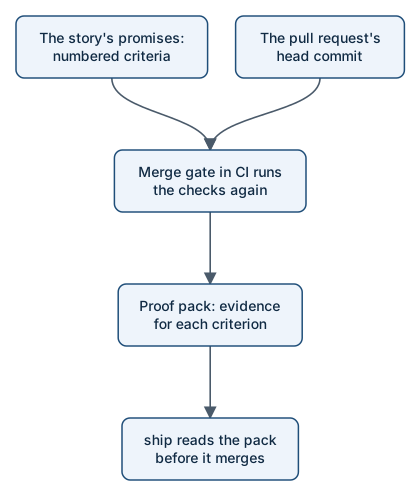
CI writes the pack, not the agent that did the work.
What is in a pack
- The story, the pull request, and the exact commit it describes.
- The fingerprint of the story's Completion Goal at Ready, so the pack is checked against what was agreed.
- For each criterion, the evidence: API traces, screenshots, recordings, screen-reader transcripts, or metrics.
- Every floor result, with the tool, its version, the value, and the threshold.
- Who wrote it, and from which CI run.
Two kinds of pack
| Kind | Written by | Counts for shipping |
|---|---|---|
| Authoritative | The merge gate, in CI, using the base branch's workflow | Yes |
| Advisory | An agent, on its own machine | No: it helps the agent, but it is a claim, not proof |
This split is the whole point. The agent that did the work never gets to certify it.
Why proof packs exist
"It works on my machine" and "the model says it is fine" are not evidence. A pack is. It lets you:
- Ship with confidence.
shiprefuses to merge without an authoritative pack for the head commit. - Answer questions later. Months on, anyone can open the pack and see what was checked, and how.
- Claim only what is true. The docs, release notes, and briefs link a Feature only when every story under it has an authoritative pack.
In the story: here is the real pack for story 131. It maps three criteria to three API-trace files and records the floors: 116 of 116 changed lines covered, no security findings, no secrets, no vulnerable dependencies.
Where packs live
The merge gate keeps each pack, screenshots and recordings included, as a file on its CI run, and posts a comment
on the pull request with each promise's verdict, the check results, and the pack's fingerprint. GitHub deletes that
file after 90 days by default ([proof] retention_days). When you run ship, it checks that the file came from the
gate's own run on the exact commit and copies the pack, without its screenshots and recordings, to the ledger
branch: a separate branch in your own repository that holds records, never code. The pack and its fingerprints stay
there for good. None of this needs a bot App, a storage bucket, or a secret.
Terms are defined in the glossary.
Under the hood: the
pack.jsonformat, field by field, is in proof packs; where packs are stored is in the ledger branch.
What's next
The checks inside a pack are called floors. See floors.