dev, rolling, main
Every change climbs the same three-rung ladder before it reaches everyone. Each rung is a branch, and each step up runs a bigger gate. That way, new work reaches early adopters fast, and stable releases stay stable.
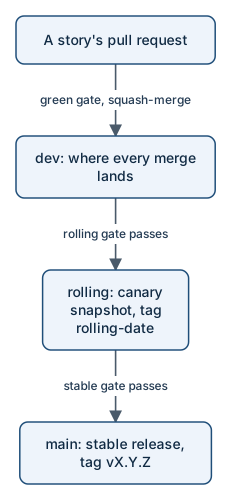
Three rungs. A gate at every step.
The three rungs
| Branch | What it is | Who uses it |
|---|---|---|
dev |
Where every merged pull request lands. Always builds, but not a release | The team, every day |
rolling |
A snapshot of dev promoted on a schedule, tagged rolling-<date> |
Early adopters who want the latest |
main |
A stable release, promoted from rolling on a deliberate decision, tagged vX.Y.Z |
Everyone else |
The gates
- Into
dev: the pull request's own checks, the merge gate, and a person's yes. - Into
rolling: the rolling gate on the exact merge commit: unit and integration tests, benchmarks, a production check, and the evals for the skills. - Into
main: everything in the rolling gate, plus longer integration tests, security scans, and install tests on Linux, macOS, and Windows. Every commit onmainis tagged and released, with a signed build.
If a gate fails, nothing moves. The fix goes into dev and climbs again.
Your product does not have to use all three rungs. If your repository has only main, init maps it and renames
nothing; add dev and rolling when you want them.
Why a ladder helps you
- Speed and stability together. People who want the newest work take
rolling. People who need calm takemain. Nobody waits for everyone. - Every release is traceable. A tag points at one commit, built by one workflow, from one gate run.
- Measurement starts on time.
releaseschedules the Goal's measurement when the work goes out.
In the story: benefits-qa reached
rollingasrolling-2026-10-12.4. Three days later, on 15 October 2026,maingot the first stable release, v0.1.0, which is what your first hour installs.
The procedure, step by step, is in Contributing. Terms are defined in the glossary.
Under the hood: the gates, signatures, and provenance of each step are in releases and the supply chain.
What's next
You have the ideas. Now see them in motion: the journey at a glance.