The verb registry and code generation
Every command aayudha has is declared once, as Go data, in internal/verbs/registry.go. The CLI reads that data
when it starts, and go generate ./... writes the verb and plumbing tables in docs/README.md, the RACI (who is Responsible, Accountable,
Consulted, and Informed), the layer map, the skill frontmatter, and the MCP tool schemas from it. CI fails when any
generated file differs from what the generators would write. This exists so that the docs, the skills, and the
binary cannot disagree about what a verb is, who owns it, or what it may touch.
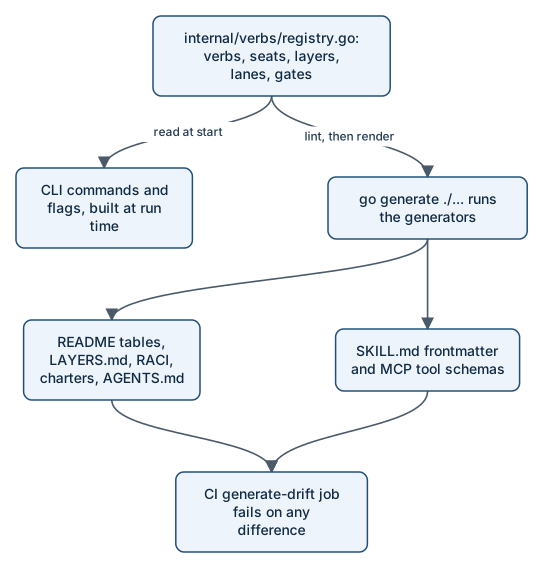
Change the registry, regenerate, commit both. Never edit a generated file by hand.
Why one source
Ground rule 4 in the build plan makes the registry the single source. Without it, a verb's seat could say one thing in the README, another in a seat charter, and a third in the skill a host loads. With it, there is one Go value per command, unit tests check that value, and every other copy is derived from it.
The registry holds more than verbs:
Verbs: the 34 verbs: the 32 of the plan, in plan order, thenchart(WP5.1g) andsurvey(WP5.9).Plumbing: the 15 plumbing commands, built with theplumbhelper (no lane, no layers, CLI only).Seats: the fourteen seats.LayerTable: the nine layers (L01 to L09), each with one owner seat and the path globs that place a file in it.Hosts: Amp, Cursor, Claude Code, and OpenAI Codex, with model families a host cannot run.Lanes: the six model lanes (build,spec,plan,review,ui-review,chore) with per-host defaults.Gates: the named preconditions a command may declare, such asmerge-gateandhuman-pass.Stages: the journey stages, in reading order. Every verb has exactly one.
The Consulted and Informed seats of each verb live beside it in internal/verbs/raci.go.
The Command struct
// Command is a verb or a plumbing command.
type Command struct {
    Name     string
    Summary  string  // one line, <= 200 chars; the SKILL.md description
    Reader   string  // one plain sentence for people new to aayudha: the docs site's verb map and journey pages; verbs only
    WP       string  // the work package that implements the command
    Stage    StageID // the journey stage (verbs only; empty for plumbing)
    Seat     SeatID  // the single Accountable seat
    Owns     SeatID  // seat that owns thresholds or policy when it differs from Seat; empty otherwise
    Lane     LaneID  // empty for plumbing
    Layers   Layers
    Inputs   []Input
    Outputs  []string
    Gates    []GateID
    Surfaces []Surface
    Identity Identity
    Mode     Mode
    ModeNote string // qualifies Mode, e.g. where the direct pass runs
    Exposure Exposure
    ReadOnly bool // never writes; still runs on a repo whose schema is newer than the binary (WP1.9)
    // Paths are glob patterns that limit when a host loads the skill on its own
    // (SKILL.md `paths`, WP3.1). Empty means no restriction and the key is omitted.
    Paths []string
}
From internal/verbs/registry.go (tabs shown as spaces). The fields that matter most:
- Summary and Reader. Two descriptions with two audiences.
Summaryis written for agents: it becomes the skill's description and the MCP tool's description.Readeris one plain sentence for people, used by the docs site's verb map and the "verbs in this step" table of each story chapter. A registry test requires every verb to have one, under 160 characters, different from itsSummary. - Seat and Owns. Exactly one Accountable seat.
Ownsnames the seat that owns the thresholds when it differs:verifyis run by the AI Native Engineer against floors the Quality Architect owns. - Layers.
AllLayers(),NoLayers(), orOnlyLayers(L09). - Inputs. Typed arguments and flags.
TypeIssueandTypePRare checked againstIssuePatternandPRPattern.HumanOnlyinputs are never exposed over MCP;ReadOnlyValuespins an input to its read-only values while MCP writes are off. - Identity.
humanorbot: the GitHub identity the command writes under. - Mode. Who reasons:
none,host,direct, orhybrid(ground rule 5). - Exposure.
read,write, orneveron MCP.
Here is a real entry:
{
    Name: "ship", WP: "WP5.5", Stage: StageShip,
    Summary: "Squash-merge a PR after a green merge gate and a human pass, write the Complete section, and clean up.",
    Reader:  "Merges a proven pull request after your yes, and writes down who approved what, on which evidence.",
    Seat:    EngineeringManager, Lane: LaneChore, Layers: AllLayers(),
    Inputs: []Input{
        pos("pr", TypePR, "Pull request to ship."),
        humanOnly(flag("solo-bypass", TypeBool, "Solo mode only (one human, no bot App): merge without a second person's approval, recorded in the PR, the ship record, and the actions log (Appendix B D2).")),
    },
    Outputs:  []string{"merge-commit", "complete-section", "status:merged"},
    Gates:    []GateID{GateMergeGate, GateHumanPass},
    Surfaces: cliSkill, Identity: IdentityHuman, Mode: ModeNone, Exposure: ExposeNever,
},
From internal/verbs/registry.go.
At run time: the CLI
The CLI is not generated. newRoot in internal/cli/root.go loops over verbs.Verbs and verbs.Plumbing and
builds one cobra command for each. newCommand derives the usage line, the positional argument count, every flag,
and enum and pattern validation from Inputs. Handlers register by name in an init function, for example
func init() { register("ship", runShip) } in internal/cli/ship.go. A registry command with no handler still
appears in aayu --help, marked "lands in" its work package, and exits with code 2.
At build time: go generate
embed.go and internal/loops/doc.go hold the go:generate directives. Each generator runs from the repository
root (or reaches it), writes only when bytes differ, and is deterministic.
| Generator | Source | Writes |
|---|---|---|
internal/verbs/gen |
the registry and raci.go |
docs/README.md verb and plumbing tables; the verb map in docs/guide/when-to-use-what.md; the generated regions of each skill page docs/guide/skills/<verb>.md (a new verb gets a page) and its index; LAYERS.md; docs/RACI.md; the RACI region of each seats/<seat>/CHARTER.md; the aayudha:raci section of AGENTS.md; skills/<verb>/SKILL.md frontmatter; internal/mcp/schemas/<verb>.json; internal/config/schema.json from the config structs |
internal/config/gen |
internal/config/defaults.toml |
CONSTRAINTS.md |
internal/workitems/gen |
the work-item schema in internal/workitems |
work-items/forms/aayudha-<type>.yml and a region of work-items/README.md |
internal/loops/gen |
loops/*.toml |
.github/workflows/aayudha-loops.yml, loops/amp/<name>.json, loops/cursor/aayudha-loops.tf |
internal/tell/gen |
docs/guide/img/*.diagram |
the .svg beside each, drawn by the brief diagram renderer |
Partial files are edited only between markers, such as <!-- BEGIN GENERATED: verbs --> in docs/README.md. A
SKILL.md keeps its hand-written body: the generator replaces only the leading frontmatter block. Stale outputs
are handled on purpose. Stale MCP schemas and SVGs are deleted. A SKILL.md for a command without the skill
surface makes generation fail, because its body is hand-written and should not vanish silently. The config
generator fails when defaults.toml has a key with no row in its table, or a row names a missing key.
This is the frontmatter generated for ship:
---
# Code generated by go generate (internal/verbs/gen); DO NOT EDIT.
# Source: internal/verbs/registry.go. Only this frontmatter is generated; the body below is hand-authored.
name: ship
description: "Squash-merge a PR after a green merge gate and a human pass, write the Complete section, and clean up."
disable-model-invocation: true
user-invocable: true
version: "0.0.0"
aayu:
  seat: engineering-manager
  lane: chore
  layers: all
  inputs:
    - name: pr
      type: pr
      required: true
      positional: true
      description: "Pull request to ship."
    - name: solo-bypass
      type: bool
      required: false
      positional: false
      description: "Solo mode only (one human, no bot App): merge without a second person's approval, recorded in the PR, the ship record, and the actions log (Appendix B D2)."
  outputs:
    - "merge-commit"
    - "complete-section"
    - "status:merged"
  gates:
    - "merge-gate"
    - "human-pass"
  identity: human
  mode: none
---
From skills/ship/SKILL.md. disable-model-invocation: true comes from Exposure: ExposeNever, so hosts do not
load the skill on their own. ship has no MCP schema for the same reason. For an exposed verb, such as verify,
the schema in internal/mcp/schemas/verify.json carries each input's type, the pull request pattern, and
x-aayu-exposure: write.
Lint, tests, and the drift check
Before it writes anything, internal/verbs/gen runs verbs.LintRACI. The lint requires one known Accountable seat
per command, a RACI entry for every verb whose Consulted and Informed seats are known, unique, and distinct from the
Accountable seat, and one known owner seat per layer. A registry that breaks it fails go generate and CI.
TestRegistry in internal/verbs/registry_test.go checks the rest: exactly 34 verbs and 15 plumbing commands in
plan order, unique names, one stage per verb, fourteen seats, nine layers, known gates and lanes, one-line summaries
of at most 200 characters, valid modes and exposures, surfaces that follow exposure, input rules (an enum has
values, a human-only input is never required), and a default for every lane on every host.
The generate-drift job in .github/workflows/ci.yml is a required check on dev. It runs go generate ./...,
fails if git status --porcelain --untracked-files=all shows any change, then runs the generators again and fails
if the second run changes anything.
      - name: Regenerate
        run: go generate ./...
      - name: Fail on drift
        run: |
          drift="$(git status --porcelain --untracked-files=all)"
          if [ -n "$drift" ]; then
            echo "::error::Generated files are out of date. Run 'go generate ./...' and commit the result; do not edit generated files by hand."
…
From .github/workflows/ci.yml.
Invariants
- Every command has exactly one Accountable seat, and every layer exactly one owner. Enforced by
verbs.LintRACIininternal/verbs/raci.go(TestLintRACI), run first byinternal/verbs/gen/main.go. - The registry holds 34 verbs and 15 plumbing commands, each with valid fields. Enforced in
internal/verbs/registry_test.go(TestRegistry). - Generated files match the registry byte for byte. Enforced by the
generate-driftjob in.github/workflows/ci.yml. - Generation is deterministic. Enforced by the second-run step of
generate-drift. - A skill's
pathskey appears only when the registry sets globs. Enforced ininternal/verbs/gen/main.go(TestFrontmatterPaths). - Every skill has the generated frontmatter keys and calls only real registry commands and flags. Enforced by
internal/skills.Lint(TestSkillLintinembed_test.go). - Every documented config default exists and every rendered key is documented. Enforced by
internal/config/gen/main.go. - The CLI lists every registry command, and an unbuilt one names its work package. Enforced in
internal/cli/cli_test.go(TestHelpNamesAayuAndListsRegistry,TestNotImplementedNamesWP).
Honest status:
SkillVersionis still"0.0.0", so every generated frontmatter saysversion: "0.0.0", even in the v0.1.0 release: the skill version is not yet tied to the release version.
Where it lives in the code
- internal/verbs/registry.go and internal/verbs/raci.go
- internal/verbs/registry_test.go
- internal/verbs/gen
- internal/config/gen
- internal/workitems/gen
- internal/loops/gen
- internal/tell/gen
- internal/cli/root.go
- internal/mcp/schemas
- .github/workflows/ci.yml