Configuration, secrets, and the audit trail
Three parts of aayudha decide what it is allowed to do and let you check, later, what it actually did. Configuration
sets the thresholds and policies. The secrets store holds keys so that no file ever does. The actions log records every
external write, and aayu audit checks that log against GitHub's own history, so a write that bypassed aayudha still
shows up.
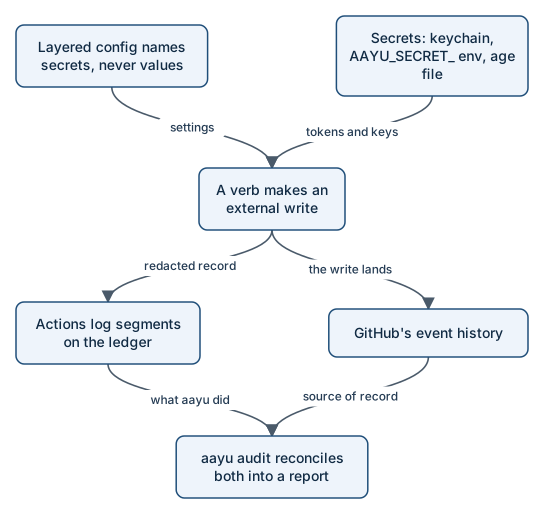
Config names secrets but never holds them. The log says what aayudha did; GitHub's history is the source of record.
Configuration layers
Why layers? A floor threshold belongs to the repository, a model preference belongs to a person, and a one-off
experiment belongs to one command. config.Load in internal/config/load.go merges six
layers, lowest precedence first:
| Layer | Source |
|---|---|
default |
internal/config/defaults.toml, embedded in the binary |
user |
~/.config/aayudha/config.toml (or under XDG_CONFIG_HOME) |
repo |
.aayudha/config.toml, committed |
local |
.aayudha/config.local.toml, ignored by Git; skipped in CI |
env |
AAYU_<SECTION>__<KEY> variables, with a double underscore between levels |
flag |
--set key=value |
Each file layer may also be JSON; TOML wins when both exist. Every layer is checked on its own before it is merged, so
an unknown key is an error that names the file, variable, or flag it came from, not a silent no-op. Files carry a
schema version; an older file is migrated in memory with a notice, and a newer one is refused. [fleet] is accepted
only in the user layer.
In CI (--ci, or GITHUB_ACTIONS=true), the local layer never applies: config loading skips
.aayudha/config.local.toml and .aayudha/config.local.json and warns, naming each file it skipped. Git ignores both
files, but git add -f still commits either one, so a pull request could otherwise commit a local file that changes
policy in every workflow, for example clearing an environment's production flag. aayu upgrade and aayu doctor
skip the local file in CI too. Outside CI the local file applies as before.
aayu config show --origin prints every merged key with the layer and source that set it, for example
autonomy.streak = 20 # default: defaults.toml (embedded). aayu config validate loads and checks without printing.
What protects the policy keys
The keys that decide what agents may do, such as floors, [autonomy], and [models], are protected by protecting the
files that hold them. internal/config/defaults.toml and .aayudha/config.toml are in .github/CODEOWNERS, and so
are .aayudha/config.json and .aayudha/config.local.{toml,json}, which a pull request could otherwise add
unreviewed. A change to any of them needs a human CODEOWNER's approval (see trust model and identities). CONSTRAINTS.md is
generated from defaults.toml, and the generate-drift check fails when the two disagree, so a default cannot be
loosened quietly. The local, env, and flag layers can still change these keys on one machine; that changes what
an agent on that machine does, but not what the protected files or CI's gate workflows say, because CI skips the
local layer.
One key is stricter. [decisions] solo_provisional_after_hours (default 24) is read only from
.aayudha/config.toml and the embedded defaults: a value in .aayudha/config.json (the repo layer, but not
an accepted source for this key), or in the user, local, env, or flag layer, fails the load, naming the file, and so does a value
under 12, the hard minimum in code (config.MinSoloProvisionalHours). With at most one human configured (paired seats' humans and [autonomy] approver), a reversible, Decision-ready Decision's recommendation
then applies provisionally after the shorter of it and provisional_after_hours (rule V8); provisional_after_hours = 0
still turns provisional application off. No mode ever applies a waiver of any kind (by label, a waives #N link, or a
title or question that says waive), a seat change, or a step the trust model keeps human-only (approving a PR,
publishing, aayu init, a protected path, a floor, or a ratchet) (decide.Decision.Excluded). aayu status and
aayu inbox list the provisional Decisions with their ratify-or-revert deadline, so a person can reverse one with
aayu decide <n> --accept <option>.
From internal/config/defaults.toml:
# Autonomy: when an agent may merge without a human pass.
[autonomy]
streak = 20
never = ["L04", "L07", "L09"]
approver = ""
correction_days = 14
…
# Proof media and retention (V3, WP4.2; run artifacts since S-4.2b).
[proof]
media = ""
retention_days = 90
Secrets
Configuration names a secret; it never holds one. A secret field accepts only a name (lowercase letters, digits, -
and _), so a pasted key fails validation with a message that ends "never the key". Values live in one of three backends in
internal/secrets, tried in this order:
keychain: the operating system keychain (macOS Keychain, Windows Credential Manager, or Secret Service on Linux).env: read-onlyAAYU_SECRET_<NAME>variables, for CI and headless machines.ai-gatewaybecomesAAYU_SECRET_AI_GATEWAY.file: an age-encrypted JSON file,~/.local/share/aayudha/secrets.age, encrypted to an identity in~/.config/aayudha/age-identity.txt. Both are written with mode 0600.
aayu auth set-secret <name> reads the value from standard input, never from arguments, and stores it in the first
writable backend. In a shell with a host's agent marker it runs only after a device-flow approval (the presence
check in how-trust.md); it needs no terminal, so a person can pipe the value in. aayu auth list-secrets reports which backend each name resolves
to, never the value. [integrations.<name>] scope marks a key read or write-capable, and a read-only verb refuses a
write-capable key (secrets.CheckScope).
Tools that a floor runs do not inherit any of this. Sandbox.Env in
internal/verify/exec.go builds each child's environment from a short allowlist
(PATH, locale, temp directories, Go and Node paths) and a fresh, throwaway HOME. No AAYU_*, GITHUB_TOKEN,
GH_*, or cloud key reaches a child, and the parent's HOME, where gh and git keep tokens, is hidden. On Linux a
floor that does not need the network runs in its own network namespace with only loopback.
The actions log
Ground rule 6 in the build plan says every external write goes through internal/actions. Log.Do wraps each write:
- Capability policy first. A write the action's capability does not allow, such as a comment from the
labels-onlytriage client, is refused before any request and logged asrefused. - Dry run. With
--dry-run, the action is logged asplannedand not performed. - Idempotency. An action with an
idempotency_keythat already completed returns the earlier record and does nothing. - Redaction. Payload keys containing
secret,password,authorization,api_key,private_key,cookie,credential, or ending intokenbecome[REDACTED], and credential-shaped strings (GitHub tokens,sk-keys, Slack tokens, private key blocks) are replaced wherever they appear, including in results and errors. - One line per action, with the outcome, wall time, tokens, and cost.
Each line has a seq, the prev hash of the line before, and its own hash: SHA-256 over the record's JSON with
hash empty. Editing, removing, inserting, or reordering a line breaks the chain. aayu actions verify-chain walks the
local log and names the first broken line; aayu actions tail and aayu actions grep read it.
The local log is .aayudha/telemetry/actions.jsonl in the main checkout, shared by every worktree of the clone. At the
end of a run, checkpoint appends that run's new lines to the ledger as
actions/<date>/<host>-<run>.jsonl, pushed with the verb's own token. Without a ledger branch the segment waits in
.aayudha/ledger-outbox. A real line, from
git show origin/ledger:actions/2026-10-12/cli-20261012T095222Z.jsonl, the merge of story 131:
{"seq":142,"time":"2026-10-12T09:52:32.270597827Z","run":"20261012T095222Z","kind":"github.pull.merge","target":"rahulnakmol/agentic-ayudha#148","story":"#131","identity":"human","request":{"method":"PUT","path":"/repos/rahulnakmol/agentic-ayudha/pulls/148/merge"},"payload":{"human_pass":"solo-bypass","method":"squash","sha":"b046d1a1d113339eb80e130c9dc0008fa223e76f"},"status":"done","result":{"sha":"f56dc67169f8fe1716d37f16703548bc0f44eef6"},"tokens_in":0,"tokens_out":0,"cost_usd":0,"wall_time_ms":2695,"attempts":1,"prev":"ec0823259553cb8826686af1006c49d56ce3722829f839d350996cf074f70b60","hash":"990aaa90087aa1df5fbbdf9d231a7d9dd96d1d7a10bf7b5288ba67b93fe38a1c"}
The audit
The actions log is aayudha's own account, and a log can be incomplete: a direct gh write, a web edit, or a run whose
segment never reached the ledger leaves no line. So the log is never the source of record. GitHub's event history is.
aayu audit in internal/audit reads both and reconciles them for a time window:
- Rule-suite bypasses. Every push a ruleset would have refused but a bypass actor made, classified as a solo-mode
bypass (only
protected-pathsfailed, and aSolo-mode bypass:comment came first), a solo-mode bypass recorded late (the comment or an incident note came after the merge), a ledger write under the founder identity, a promotion, a tag bypass, or other. Any it cannot explain is counted as unexplained. - Solo-mode human passes from ship records, and plan-review bypasses.
- Human-fallback writes, from actions records and ledger commit trailers.
- Unlogged writes. Each write in GitHub's history (timelines, creations, workflow dispatches, ledger commits) is
matched to an actions record with the same request and target within 10 minutes (
Tolerance). Workflow and App writes are counted separately, since their runs record them. - Proof coverage, floors, and waivers. Which delivered stories have an authoritative pack that maps every Ready criterion, matches its hashes, and whose floors hold.
- Decision SLAs in business hours, autonomy exceptions (corrections, agent merges on never layers), and a
licence scan of
go.mod.
The report goes to audit/<date>/audit-<time>.md on the ledger, beside an .inputs.json snapshot of what GitHub
returned. GitHub's history changes and rule suites are listed for only about a month, so
aayu audit --replay <snapshot> regenerates the report byte for byte from the snapshot, and --since, --until, and --ledger re-read
GitHub with the same inputs. The report's config hash covers only what audit reads ([identity] bot_logins,
[decisions], [time], [autonomy], [proof], [budget] per_story_usd, the dev branch), so a key added for another
feature leaves a report replayable; a replay refuses when one of those changed. Reports written before 15 October 2026
recorded a hash of the whole configuration, which no later binary can recompute, so their replay is checked by the
byte comparison alone. The next run starts where the last report's cursor stopped.
The summary of the latest report on this repository's ledger,
audit/2026-10-12/audit-20261012T063500Z.md:
## Summary

- Rule-suite bypasses: 105; accounted for 105; **unexplained 0**
  - solo-mode bypasses (protected-path merges): 41
  - ledger writes under the founder identity (D1 day-one rule): 57
  - promotions to rolling or main: 3
  - tag ruleset bypasses: 2
  - solo-mode bypasses whose record came after the merge (recorded late): 1
- Solo-mode human passes (`ship --solo-bypass`): 2
- Human-fallback writes: 171
- GitHub writes in the window: 827; in an actions segment 100; by workflows and Apps 10; **not in any actions segment 717**
- Proof coverage: 2/33 delivered stories and bugs; merged without proof (pre-gate) 19; merged without proof (post-gate) 12
- Floor misses in authoritative packs: 0; waived floors: 0
- Decisions over their SLA: 0
- Autonomy exceptions: 0 corrections; 0 agent merges on never-layers
- Licence findings: 0 (68 go.mod modules); CI `security` job on the code commit: no completed run
The rest of the report has one section per line of the summary, each listing the items behind the count.
Invariants
- An unknown configuration key is an error that names its source. Enforced in
internal/config/load.go(TestRejects,TestPrecedence). - A secret value is never accepted where config expects a name, never read from a command-line argument, and never
written to disk in plain text. Enforced in
internal/config/config.goandinternal/cli/auth.go(TestSecretCanary). - A floor's child process sees no credential variable and not the user's
HOME. Enforced ininternal/verify/exec.go(TestChildEnvironmentIsScrubbed). - Dry run performs nothing, a repeated idempotency key performs nothing, and secrets are redacted before a line is
written. Enforced in
internal/actions/actions.goandinternal/actions/policy.go(TestDryRunPlansAndPerformsNothing,TestIdempotencyRedactionAndSegments,TestLabelsOnlyCapability). - Any edit, removal, or reordering of a log line is detected. Enforced by
VerifyChain(TestChainDetectsTampering). - A GitHub write with no matching actions record is reported, not hidden, and a report can be regenerated byte for
byte. Enforced in
internal/audit/reconcile.goandinternal/cli/audit.go(TestAuditFlagsUnloggedWrite,TestLoggedMatching,TestAuditRerunByteIdentical). - A solo-mode bypass whose comment came after the merge is reported as recorded late. Enforced in
internal/audit/audit.go(TestClassifyBypasses,TestAuditBypassRecordedLate).
Where it lives in the code
- internal/config: layers, schema, validation, and defaults.toml.
- internal/cli/config.go:
aayu config. - internal/secrets: the three backends.
- internal/cli/auth.go:
aayu auth. - internal/verify/exec.go: the scrubbed child environment.
- internal/actions:
Log.Do, redaction, capabilities, and the hash chain. - internal/cli/actions.go:
aayu actionsand the checkpoint to the ledger. - internal/audit and internal/cli/audit.go:
aayu audit. - CONSTRAINTS.md: the defaults, generated.
Honest status: actions segments only reached the ledger from 2026-10-12 onward. Of the 717 writes the latest audit counts as "not in any actions segment", about 590 were made before the first segment (2026-10-12T02:33Z), while this repository was being bootstrapped; the rest are direct
gh, web, or ledger writes that no segment recorded.auditcounts them as unlogged rather than hiding them. Only 2 of 33 delivered stories had an authoritative pack in that window: 19 merged before the merge gate was registered, and 12 merged after it without one; the report lists both groups as uncovered. There is no bot App here, so audit runs, and every other agent write, go out under the founder's token taggedidentity:human-fallback.
Read next
- The ledger branch: where segments and reports are stored.
- Security: the threat model these controls answer.