The nine layers
Every application, however small, has the same kinds of parts: screens, an API, business rules, data, and so on. aayudha names nine of them, the layers. Each one has an owner seat, and each changed file belongs to exactly one layer, matched by its path. So every story knows which parts it touches, its footprint, and who should look at them.
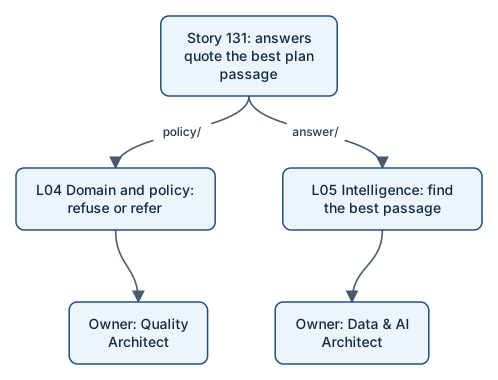
Story 131's footprint: two layers, two owners.
The layers, in plain words
| Layer | What it is | In benefits-qa |
|---|---|---|
| L01 Experience | What people see and use | web/, the Ask page |
| L02 Interaction and API | The doors into the app | api/ and cmd/ |
| L03 Application and workflow | The steps that tie things together | ask/, the question workflow |
| L04 Domain and policy | The rules of the business | policy/, what may be answered |
| L05 Intelligence | Search, ranking, and models | answer/, finding the best passage |
| L06 Contracts and integration | Agreements with other systems | contracts/, the API schema |
| L07 Operational data and state | What the app stores | store/, the plan documents |
| L08 Analytics and reporting | What the app measures | analytics/, the event export |
| L09 Platform and operations | How it runs and ships | deploy/, the run script |
The five benefits-qa stories touched all nine layers between them.
Why layers help you
- Plans you can follow. A story's plan has one checkpoint per layer, so the agent changes one kind of thing at a time, and each checkpoint is checked on its own.
- The right reviewer. Each layer's owner seat, and its paired person if there is one, reviews changes there.
- Extra care where it counts. Three layers are marked "never" by default, meaning agents never merge there on their own: domain policy (L04), stored data (L07), and the platform (L09). Changes there always need a person's review of the plan and a person's approval to merge, however good the agents' record is.
- Only the checks that matter. The screen-reader floor, for example, runs only for stories that touch L01, the experience layer.
Which folders belong to which layer is yours to set: a product lists its path patterns in its own LAYERS.md, so
any folder layout works. The rules for this repository are in the Layers reference. Terms are defined in the
glossary.
Under the hood: how a changed path is matched to a layer, and how the footprint decides which checks run, is in floors in detail and the verb registry.
What's next
How does a story prove it kept its promises in each layer? See proof packs.