Run it alone: the solo founder
You are one person with a product to build. aayudha puts an agent twin in every one of its fourteen seats, so the interviewing, planning, building, checking, and reporting happen without you. What stays with you are the steps only a person may take, and GitHub will not even let you approve your own pull request. This page shows what you still do by hand, how to keep most of it in one list, and how the agents earn the right to need you less.
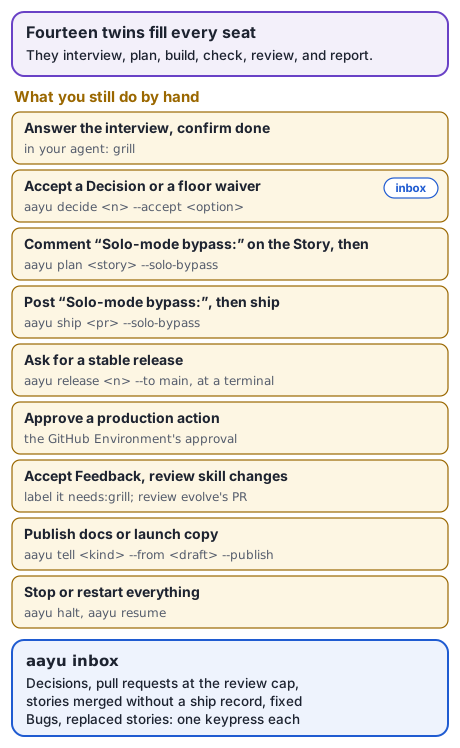
The agents do the work. You keep the decisions, and one inbox holds most of them.
What you still do by hand
Each step below is one that only a person may take: a choice, a yes, or a brake.
| Step | How |
|---|---|
| Answer the interview and confirm what done looks like | In your agent: grill |
| Accept a Decision or a floor waiver | aayu decide <n> --accept <option> (decide) |
| Review a plan that touches a risky layer | A comment on the Story starting Solo-mode bypass:, then aayu plan <story> --solo-bypass, recorded as no review (plan) |
| Merge a proven pull request | A comment starting Solo-mode bypass:, then aayu ship <pr> --solo-bypass (ship) |
| Ask for a stable release | aayu release <n> --to main in your terminal, or a comment on the Release issue: Stable release: v1.2.0 (release) |
| Approve a production action | Approve the waiting run's GitHub Environment (respond) |
| Accept Feedback and review skill changes | Label the Feedback needs:grill; review evolve's pull request (retro, evolve) |
| Publish docs or launch copy | aayu tell <kind> --from <draft> --publish (tell) |
| Stop or restart everything | aayu halt --reason "<why>", then aayu resume |
With a bot App installed (aayu init --identity), the agents' pull requests are the App's, not yours, so you can
review them as a person and the two bypass rows change: approve a risky plan with aayu plan <story> --approve, and
approve the pull request on GitHub, then run aayu ship <pr> without --solo-bypass. The bypass is refused once an
App is installed.
decide --accept, plan --solo-bypass, ship --solo-bypass, tell --publish, resume, and inbox are a
person's to run. Run them in your own terminal and they just work. aayu's own agent lanes and CI are always refused,
and in Claude Code, Codex, and Cursor the hook aayu installs blocks them before they run. In a shell that carries an
agent's marker, such as an orb's Terminal tab, the command cannot tell you from an agent, so it asks you to approve
through GitHub's device flow: open the link it prints on any device, enter the code, and approve
(approving from any device).
Two commands are different on purpose. Once you have asked for a stable release, an agent may run aayu release to
carry it out; your request is the gate. And anyone, agent included, may pull the brake with aayu halt; only a person
releases it with aayu resume.
The solo-mode bypass, in the open
GitHub does not let you approve your own pull request, so a true human pass is impossible alone. aayudha does not
fake one. You say so in a comment that starts with Solo-mode bypass: and gives the reason, then run the command:
aayu ship <pr> --solo-bypass
You should see the pull request merged, with "Human pass: none possible" and a link to your comment in the ship
record. audit lists every bypass in its own section. The bypass is refused when an agent runs it,
when your comment is missing, when a bot App is installed, or when a second person holds a paired seat: then someone
can review, so someone must. Stuck? See ship problems.
One list: the inbox
Working alone, you should not be the reason work waits. There is no switch that turns the human-only gates off, because an agent could flip it. Instead, one command gathers most of the human-only steps that wait for you, each with the twin's recommendation:
aayu inbox
It lists open Decisions (floor waivers and provisional ones included), pull requests whose merge gate waits for your
review (one device code approves several, each as aayu inspect <pr> --approve does), pull requests where the review
stopped after its two fix rounds, stories whose pull request merged without a ship record, Bugs whose fix merged, and
stories that another story replaced. It does not list a pull request waiting for your approval on GitHub or a plan
waiting for plan --approve; with a bot App installed, find those in GitHub's review requests. Every write is yours,
under your own token, and logged.
You should see the list on the left and the selected item's card on the right (the list above the card on a
narrow terminal). The list is grouped: Needs you now, Waiting on the review cap, Housekeeping, and Done this session,
each with its count. Each row has the item's icon, number, title, why it waits, and how long since it changed, in
columns that line up on every row.
The card says what the item is in one plain line, then the counsel of the seat's twin (Atri for a Decision, Drona for
a pull request, Vidhi for the housekeeping): what it is, the one link it rests on, what it recommends and why, labelled
counsel, not approval. Atri's counsel is the one posted on the Decision with aayu counsel --post; every other counsel
is written from the facts the inbox read, never by a model, so the inbox opens at once. Below it are numbered choices,
the recommendation first and selected: Enter starts it in the background and the next card appears at once, so you
can act on the next item while it runs. Go back to it and its card shows what is happening now, its steps, and how
long it usually takes; once it is done, what changed on GitHub and what happens next. A digit selects another choice and
Enter does it after saying what it writes; a one-way door also asks for Enter again. s skips to the next card, j
and k move, Tab goes to the next item that needs you, / (or Ctrl+K) finds any item or choice by typing, x and
X select housekeeping (never an item that needs you) and C clears all of it after one confirmation, ? explains
the card in plain words, and q quits; the mouse clicks rows and choices. The inbox opens
from your last read (kept in your user state directory, never in the repository) and refreshes behind the card every
45 seconds or on R, reading again the pull request behind each Ready to ship card. A card GitHub would refuse now
(it conflicts with dev or is behind it, a required check failed or is still running, or new commits came after ship
checked it) moves to "Not ready yet": it says why and who acts next in plain words, offers nothing to press, and d
shows what GitHub said. Before any write the inbox reads that item again, and if it changed it shows the new card and
writes nothing. With --plain, TERM=dumb, or [ui] plain = true the same cards come line by line, fitted to the
terminal's width.
When it has steps, aayu with no command shows "Waiting in your inbox" with the count, and aayu next names
aayu inbox. Add --dry-run to see what each key would write. The inbox runs only in your own terminal; agents are
refused. An agent may show you aayu inbox --list, the same cards read-only (Markdown, or JSON
with --json); /aayudha:inbox in Claude Code, Codex, and Cursor runs it. In Claude Code or Codex, open a terminal
for aayu inbox itself: their ! shell mode gives it no keyboard. Away from a terminal, act on each item on GitHub.
Decisions that do not wait forever
A Decision records a real choice with options and a recommendation, and only you accept it. When you are busy, the
decisions loop counts business hours in your [time] zone and pages you after 24. Working alone, a reversible
Decision's recommendation also applies provisionally at that point: labelled decision:provisional, with a date
by which you ratify or revert it. The inbox lists provisional Decisions with "ratify" as the recommendation.
The window grows to 48 hours once aayu counts two people: the people in paired seats plus [autonomy] approver. When
you pair your first teammate, set the approver to your own login, or the pod still counts as one person.
Some Decisions always wait for you, however long it takes: a one-way door, a waiver of any kind, a seat change, and
anything only a person may do, such as a change to the floors, the skills, or the protected config. The solo window
is [decisions] solo_provisional_after_hours, read only from the protected .aayudha/config.toml and never below 12
hours (configuration).
Autonomy the agents earn
A layer can earn the right to merge without your review. After 20 merges in a row on that layer with no correction (no
requested changes, no commit by a person, no revert, no linked Bug), ship records a change there as
autonomous instead of waiting for a review. A protected workflow computes the streak from the merge history, so no
agent can change it. One correction resets it.
The risky layers never earn it: L04 domain policy, L07 stored data, and L09 the platform always need a person who owns those paths, whatever the streak.
Without a bot App, the agents write as you, and their pull requests carry the identity:human-fallback label; the
streak counts them as agent work all the same. With an App (aayu init --identity), the agents write as their own
identity, and the streak workflow also records each correction on the ledger (adopt at your own pace).
When a second person joins
Solo mode ends seat by seat. Pair the person with the seats they care about, one command each, and the twin keeps doing the work while the person reviews it.
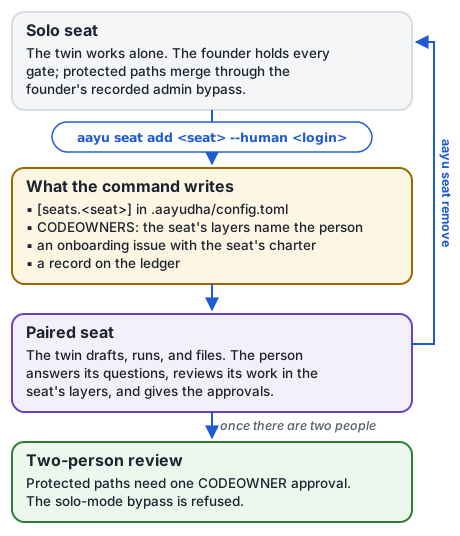
Pairing is one command, and it changes who must review.
aayu seat add code-architect --human <github-login>
aayu seat list
You should see policy: two-human pending from aayu seat add, an onboarding issue addressed to the person, and
the seat as paired with their login and layers in aayu seat list. The command changes protected files, so commit
them through a pull request. Until that merges, trust the seat add line: seat list reads your local CODEOWNERS and
already says two-human. Once it merges, run the same aayu seat add again: it now reports policy: two-human, one
CODEOWNER's approval is enough, and the solo-mode bypass is refused for protected paths. The second person reviews
instead.
aayu seat remove <seat> returns a seat to solo and hands its person's open stories back to the twin.
Honest status: a repository adopted with
aayu inithas noprotected-paths-codeowner-reviewruleset and no solo-mode gate. With one human, GitHub itself enforces no review on protected paths (shipstill does), andseat addreportspolicy: n/a.Once the second person's CODEOWNERS change has merged, the second
seat addcreates the ruleset: one CODEOWNER approval on your dev branch, with no bypass. It needs a token with Administration: write, and a private repository needs a GitHub plan with rulesets;seat removedeletes it again.
What can go wrong
- A command says it is for a person. You ran it from your agent, or with no terminal. Run it in your own terminal, or approve the device-flow prompt it prints when your shell carries an agent's marker.
- The bypass is refused with a second person paired. Good: ask them to review. See when a second person joins.
- Work stops everywhere. Someone ran
aayu halt, which stops every agent, loop, and workflow untilaayu resume. Or a spend limit tripped: agent lanes pause and a person is paged (exit 6).
Under the hood
How a person's approval is told apart from a bot's, what the bypass checks, and how the inbox reads the record are in
trust and identities. The default streak and risky layers are in
CONSTRAINTS.md, and the Decision hours in [decisions] of your config.
What's next
- Meet the twins doing the work: your agentic team.
- See solo mode on a real day: the yes.