Adopt at your own pace
You do not have to adopt everything at once. aayudha comes in three levels. Each one is a complete place to stop: it pays for itself on its own, and you can stay there as long as you like. Move up when the next level solves a problem you actually have.
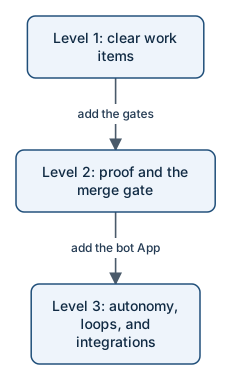
Three levels. Each step up adds one piece of setup.
Level 1: clear work items
What you run: aayu tour (which runs init and install), then grill, ready, and status.
What it gives you: every piece of work starts as a well-formed GitHub issue: Goals with a baseline and a target,
Features with a scope, and stories with numbered criteria that say what "done" means. Ready snapshots catch
promises that quietly change. status rolls it all up per Goal.
What it costs:
| Cost | At Level 1 |
|---|---|
| Keys | None beyond your own GitHub sign-in |
| CI changes | None: init adds issue forms, labels, a config file, and a records branch, but no workflows |
| CI minutes | None |
| Model spend | Only what your agent already uses: grill runs inside Claude Code, Codex, Cursor, or Amp |
Good for: trying aayudha on a real project in an afternoon, and teams whose main pain is fuzzy requirements.
Well done: if you finished your first hour, you are already at Level 1.
Level 2: proof and the merge gate
What you run: init --gates, then verify, inspect, and ship on every pull request. Your agent can now
build stories end to end, or hand them to another agent's cloud (hand work to an agent). Add a
feature map (init --verify-skill) and the gate also runs behaviour checks
(prove a behaviour change).
What it gives you: every story's pull request is checked in CI against fixed floors (coverage, security, secrets, dependencies, and, for screens, accessibility and speed). Each one gets an authoritative proof pack and a review against its criteria, and merges only with a person's yes. This is where "trust me" becomes "here is the evidence".
What it costs:
| Cost | At Level 2 |
|---|---|
| Keys | One in CI: the review model's key, as the secret AAYU_REVIEW_MODEL_KEY in the repository's code-review environment, which only the base branches and the default branch can reach. A review app can review instead, with no key in CI. Triage runs from your own agent |
| CI changes | New workflows: the merge gate, a guard that removes Ready when a story is edited, and an incident runner you trigger by hand |
| CI minutes | About 10 minutes per push to a story's pull request in this repository (8 for the floors, 2 for the review); yours depend on your tests |
| Model spend | The review model's calls, billed by its provider to your key. [budget] per_pr_inspect_max caps each pull request at 5 USD by default; a diff over 120 kB can go past it by the review parts already started (known limits). A review app bills through your own subscription to it instead |
| Storage | None to set up: screenshots and recordings stay in each CI run's aayudha-pack file for [proof] retention_days (90 by default, GitHub's limit is 90 days on a public repository), and ship copies the pack without them to the ledger. A private bucket (S3, R2, Azure Blob Storage, or Google Cloud Storage) is optional, for longer retention |
Needs setup: the review model's key, as the secret
AAYU_REVIEW_MODEL_KEYin Settings → Environments → code-review, whichaayu init --gatescreates (code review in the merge gate). Or a review app installed on your account, named in[inspect] reviewerand[inspect] appsin the pull request that adds the merge gate. A private repository on GitHub Free has no environments, so there init cannot createcode-review: choose a review app, or set[inspect] reviewer = "human"with[autonomy] approverset to the person who reviews, or make the repository public or upgrade. Proof needs no bot App, bucket, or secret: the pack waits as a file on the CI run with a comment on the pull request, andshipchecks it came from that run and records it under your name.
Good for: teams that let agents write real code and need to know it is safe to merge.
Level 3: autonomy, loops, and integrations
What you run: init --identity for the bot App, [autonomy] settings, install --loops for scheduled and
event loops, and init --integrations for PostHog, Sentry, and your cloud.
What it gives you:
- A bot identity. Agents write as a GitHub App, so their work is clearly theirs and a person's approval is clearly a person's.
- Earned autonomy. After 20 correction-free merges on a layer, agents may merge there without waiting for a person. Risky layers (domain policy, stored data, and the platform) always need a person, however long the streak. A protected workflow computes the streak, so no agent can fake it.
- Loops. Scheduled and event-driven runs keep the system moving: triage on arrival, Friday housekeeping, a failed check sent back to its builder, measurement after a release, a daily founder digest, a weekly retro, and a monthly skill evolution. They run in your agent's own scheduler, in your own session; where a host has no trigger for an event, your next session picks it up (keep things moving with loops).
- Integrations. Baselines and results come straight from PostHog, Sentry, Azure, AWS, or Google Cloud, and experiments can run on PostHog feature flags. Cloud access is read-only and keyless (see Azure, AWS, and Google Cloud).
What it costs:
| Cost | At Level 3 |
|---|---|
| Keys | The GitHub App is free; init creates it and stores its key as a secret. Read-only tokens for PostHog and Sentry. Read-only cloud access, with no stored key when it runs in GitHub Actions |
| CI changes | Optional: a loops workflow that only records events, with no model |
| CI minutes | Little: loops run in your agent's scheduler, and the Actions fallback is capped at 2,000 minutes a month by default |
| Model spend | Loops and autonomous merges use your agent more often, billed by your agent's plan as usual. Default caps on metered (pay-as-you-go) spend: 60 USD per story and 100 USD per day per repository; subscription use is not counted. When a cap trips, agents pause and a person is paged |
| Other | PostHog bills by usage on its side; Sentry adds no cost |
Honest status: this repository runs at Level 2, with some loops. It has no bot App installed yet, so its agents write as the founder, tagged as such, and autonomous merges stay off. Its triage loops run live in Amp. Level 3 is built; this repository has not switched all of it on.
Good for: teams with a steady flow of work who want the agents to carry more of it, with the guard rails switched on.
How to move up
| From | To | Run |
|---|---|---|
| Nothing | Level 1 | aayu tour (it runs aayu init, then aayu install --host <your host> --apply) |
| Level 1 | Level 2 | aayu init --gates, commit the new workflows through a pull request, and add AAYU_REVIEW_MODEL_KEY to the code-review environment (or name a review app in [inspect] reviewer and [inspect] apps in that same pull request) |
| Level 2 | Level 3 | aayu init --identity, aayu install --loops, then aayu init --integrations for the services you use |
Every step is idempotent: running it again changes nothing. And aayu uninit removes what init created.
What's next
- At Level 1? Follow the journey up to step 3, and stop there for now.
- Ready for Level 2? Read Prove it to see what the merge gate gives you.
- Want the ideas behind the levels? See the human pass and solo mode and floors.